






The Pollen Puzzle in Central India
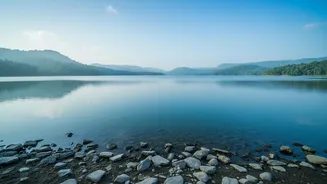
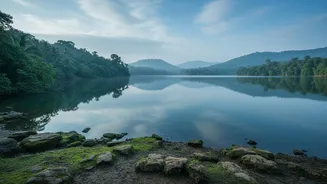
Scientists recently made a fascinating discovery by studying ancient pollen preserved in the sediment of Raja Rani Lake in Chhattisgarh’s Korba district. The study, from the Birbal Sahni Institute of Palaeosciences, analysed a 40-centimetre sediment core
that held an environmental record spanning roughly 2,500 years. By identifying the types of microscopic pollen grains in the layers, they found that the Indian Summer Monsoon was likely much stronger during the medieval period (roughly 1060 CE to 1725 CE) than previously thought. The evidence pointed to a landscape dominated by moist tropical forests, suggesting a warm and humid climate. On its own, this is an important finding for understanding past climate patterns. But a pollen count is only one piece of the puzzle. For a complete picture, scientists look deeper into the mud that preserved it.
A Lake's Secret Diary
Every lake is a patient historian. Year after year, dust, pollen, ash, and organic matter settle on its floor, forming thin layers of sediment. These layers, much like the rings of a tree, create a timeline that can stretch back thousands of years. The study of this natural archive is called paleolimnology. Scientists can extract long, cylindrical cores of this mud to read the history of the surrounding environment page by page. Because the material is often undisturbed by oxygen or other elements, it preserves a remarkably detailed record of the past. A single core can reveal ancient droughts, volcanic eruptions, the arrival of new plant species, and the first impacts of human activity. It’s a time capsule that provides essential context for any single piece of evidence, like pollen.
More Than Just Pollen
While pollen tells scientists which plants were growing, other clues in the sediment fill in the rest of the story. For instance, tiny fragments of charcoal indicate past fires. An increase in charcoal alongside a shift from tree pollen to grass pollen might suggest that early humans were clearing forests for agriculture. Chemical analysis of the sediment layers can reveal changes in temperature and rainfall. Scientists also study the preserved silica-based shells of microscopic algae called diatoms. Different diatom species thrive in different water conditions, so a change in the dominant species can signal shifts in water quality and nutrient levels, which are often linked to land use and climate change. By combining these different lines of evidence—pollen, charcoal, chemicals, and diatoms—researchers can build a rich, multi-dimensional picture of how an entire ecosystem has changed.
Why This Ancient History Matters Today
Understanding the past climate of regions like Chhattisgarh, which lies in India's Core Monsoon Zone, is crucial. By reconstructing a detailed history of monsoon intensity and vegetation changes, scientists can create a baseline for our current environment. This long-term data helps them distinguish between natural climate variability and changes driven by modern human activity. For example, the Raja Rani Lake study helps confirm that the monsoon has always been a dynamic system, but it also provides a benchmark against which we can measure the unprecedented speed of today's changes. This historical context is vital for creating more accurate climate models and making informed decisions about water management, agriculture, and conservation in a warming world. It helps us understand which ecosystems are resilient and which are on the verge of collapse.