





What Are Super-Earths?
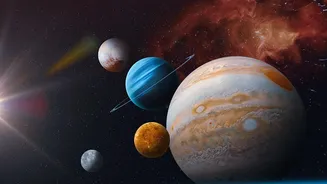
Super-Earths are a class of exoplanet—planets outside our solar system—unlike anything we have here. They are larger and more massive than Earth but smaller than our ice giants like Neptune. This category of planet is surprisingly common throughout the
galaxy, making up a significant fraction of the thousands of exoplanets discovered so far. Their size and mass mean they could be rocky like Earth or have a combination of rock and gas. Because our own solar system lacks a super-Earth, they remain shrouded in mystery, making them a prime target for astronomers trying to understand the diversity of planets in the cosmos. Their potential to have thicker atmospheres and stronger magnetic fields than Earth makes them compelling candidates in the search for habitable worlds.
How Webb 'Sees' an Atmosphere
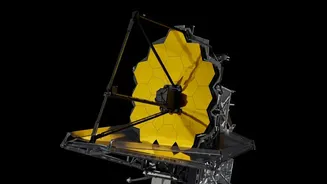
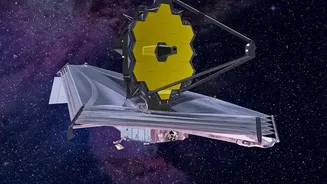
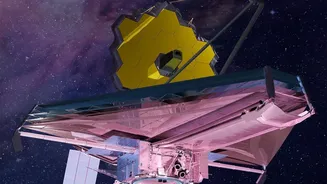
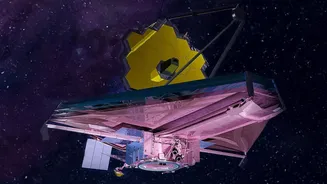
The JWST doesn't directly see clouds or oceans on these distant planets. Instead, it uses a technique called transmission spectroscopy. When a planet passes in front of its host star from our perspective—an event called a transit—a tiny fraction of the starlight filters through the planet's atmosphere. The powerful and highly sensitive instruments aboard the JWST, specifically its spectrographs, can analyze this light. Different molecules in an atmosphere absorb specific wavelengths, or colours, of light. By looking at which parts of the light spectrum are missing after passing through the atmosphere, scientists can identify the chemical fingerprints of molecules like water, methane, and carbon dioxide. It’s like analysing a barcode made of light to read a planet’s atmospheric ingredients.
The Landmark Detection
Recent observations have focused on rocky exoplanets like GJ 486 b, a super-Earth about 30 percent larger than our own planet. Using its Near-Infrared Spectrograph (NIRSpec), the JWST detected hints of water vapour. This is a significant finding because while water has been found on giant gas planets before, detecting any kind of atmosphere around a rocky exoplanet has been a major challenge. However, scientists are proceeding with caution. The planet in question, GJ 486 b, orbits its star so closely that its surface temperature is a scorching 430 degrees Celsius. Researchers are carefully working to confirm if the water signal is truly from a planetary atmosphere or if it originates from the cool starspots of the host star itself, an M-dwarf star which can have water vapour in its outer layers.
Why Water Vapour Is Crucial
Water is considered essential for life as we know it, acting as a universal solvent that facilitates the chemical reactions necessary for biology. Finding water vapour in the atmosphere of a rocky planet, even an extremely hot one, is a game-changer. It suggests that planets formed in other solar systems could have the raw materials for habitability. For a planet like GJ 486 b, which is blasted by stellar radiation, having an atmosphere at all would be remarkable. It would imply that the planet has a mechanism to continuously replenish its atmosphere, possibly through volcanic activity ejecting steam from its interior. This discovery opens the door to studying the prevalence and diversity of atmospheres on rocky planets across the galaxy.
The Next Frontier in Astronomy
This detection is more than just a single discovery; it's a proof of concept for the power of the James Webb Space Telescope. It demonstrates the observatory's ability to probe the chemical makeup of small, rocky worlds, a feat that was previously impossible. Future observations with other JWST instruments will be needed to confirm if the water vapour is definitively tied to the planet. Scientists will now expand their search, turning the telescope towards other super-Earths, including those in the 'habitable zone' of their stars, where temperatures could allow for liquid water to exist on the surface. These findings mark the beginning of a new era in exoplanet research, moving from simply detecting planets to characterising them in detail and assessing their potential to host life.