





The Sun's One-Two Punch
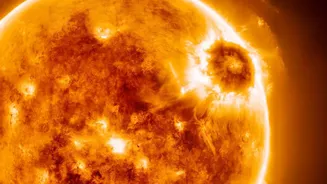
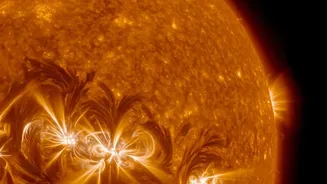
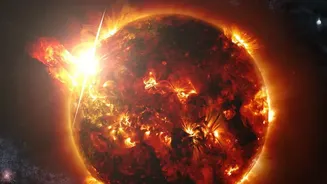
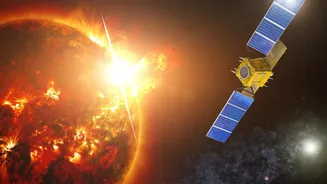
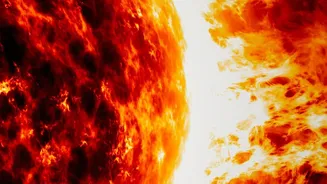
When we think of solar storms, we often picture a solar flare—a brilliant, intense flash of radiation from the Sun's surface. While these flares are dramatic, the greater threat to our infrastructure often comes from a related event: a Coronal Mass Ejection
(CME). A CME is a colossal eruption of plasma and magnetic fields from the Sun's outer atmosphere, the corona. These clouds of magnetized particles can contain billions of tons of material and travel through space at speeds of hundreds or even thousands of kilometers per second. While flares can disrupt radio communications on the sunlit side of Earth, it's the Earth-directed CMEs that have the potential to wreak havoc on our power grids.
Creating an Artificial Eclipse in Space
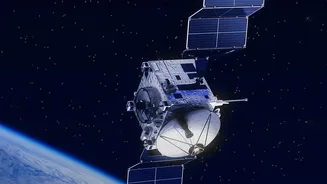
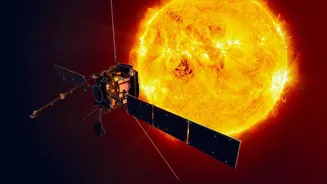
To spot a CME leaving the Sun, scientists need to overcome a fundamental problem: the Sun itself is blindingly bright, and its faint corona is a billion times dimmer. The solution is an instrument called a coronagraph. Found on satellites like the Solar and Heliospheric Observatory (SOHO), a coronagraph uses a solid disk to block the direct light from the Sun, creating a perpetual, artificial eclipse. This allows it to continuously monitor the much fainter corona. When a CME erupts, the coronagraph captures images of the massive cloud of material expanding and moving away from the Sun. By tracking its trajectory, agencies like NOAA's Space Weather Prediction Center (SWPC) can determine if it's headed for Earth.
The Real Danger: A Current From Nowhere
When a CME collides with Earth's magnetosphere, our planet's natural magnetic shield, it triggers a geomagnetic storm. This disturbance in the magnetic field induces electrical currents in the ground. These are called geomagnetically induced currents, or GICs. Long conductors, like high-voltage transmission lines and pipelines, act like giant antennas, picking up these quasi-DC currents. Power grids are designed for alternating current (AC), not the direct current (DC) nature of GICs. This rogue current flows into large power transformers, causing them to saturate. A saturated transformer can overheat, sustain damage, and draw excessive reactive power, potentially leading to voltage instability, harmonic distortions, and, in a worst-case scenario, cascading blackouts.
How an Early Warning Saves the Grid
Depending on its speed, a CME can take anywhere from 15 hours to several days to travel from the Sun to Earth. This travel time is a critical window for action. Based on data from coronagraphs and other solar wind-monitoring satellites like the Deep Space Climate Observatory (DSCOVR), the SWPC issues watches and warnings. Armed with this notice, power grid operators aren't helpless. They can take specific protective measures to enhance grid stability. These actions include postponing high-risk maintenance, reconfiguring the power flow across the system, bringing extra generation capacity online to provide voltage support, and in some cases, intentionally taking the most vulnerable transformers offline before the storm hits to prevent permanent damage. These seemingly small adjustments can prevent catastrophic equipment failure and widespread outages.