




Centaurus A: A Galactic Collision Unveiled
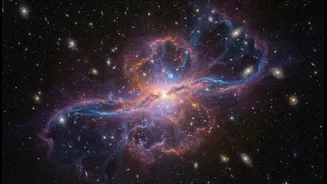
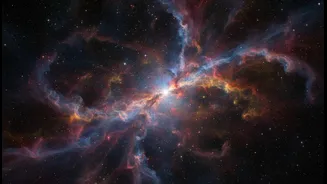
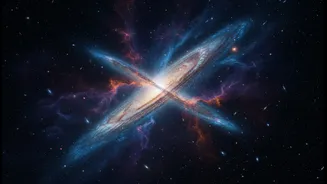
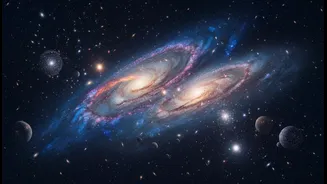
To celebrate its fourth anniversary in July 2026, the James Webb Space Telescope (JWST) released a stunning new view of Centaurus A. Located about 11 million light-years away, this galaxy is a chaotic and beautiful mess, the result of a collision between
two galaxies billions of years ago. While the Hubble telescope's view was obscured by thick lanes of dust, JWST’s infrared cameras peer through the haze, revealing millions of individual stars and the complex interplay around the galaxy's active supermassive black hole. This new level of detail allows scientists to perform 'galactic archaeology,' studying individual stars to piece together a timeline of the galaxy's violent past and understand how such collisions shape the cosmos. It’s a vivid record of cosmic history, showing how a black hole can both trigger star formation and limit it.
The Pillars of Creation, Reimagined
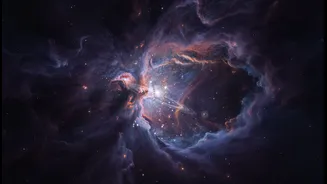
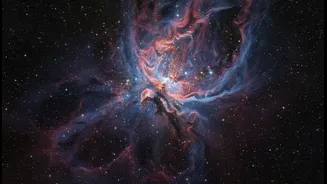
First made famous by the Hubble Space Telescope in 1995, the 'Pillars of Creation' is one of astronomy's most iconic images. These towering columns of cool hydrogen gas and dust in the Eagle Nebula are stellar nurseries, regions where new stars are born. For decades, they were seen as dark, impenetrable structures. But when the James Webb Space Telescope turned its infrared eye on them, it pierced through the dust, revealing dozens of newly formed, bright red stars that were previously hidden. This view confirmed that star birth is still very much active at the tips of the pillars. By combining views from different telescopes like Hubble, Chandra, and Webb, astronomers get a more complete picture, transforming the pillars from a beautiful snapshot into an evolving scientific story.
Euclid's Dazzling Wide-Angle Universe
While Webb and Hubble focus on small patches of the sky in incredible detail, ESA's Euclid telescope is built for the bigger picture. Its mission is to create the most extensive 3D map of the universe yet, primarily to investigate the mysteries of dark matter and dark energy. Its first images showcased this unique capability, capturing the entire Perseus galaxy cluster in a single shot. This image alone shows 1,000 galaxies in the cluster and more than 100,000 more distant galaxies in the background, many of which had never been seen before. Unlike targeted telescopes, Euclid can capture vast areas of the sky with sharp resolution in a short amount of time, revealing the large-scale structures that dark matter has shaped over billions of years.
A Stellar Sparkler in Messier 3
Not all cosmic beauty is in distant galaxies. In July 2026, to mark the United States' 250th anniversary, NASA released a dazzling Hubble portrait of Messier 3, a globular cluster within our own Milky Way. Globular clusters are ancient, tightly packed spheres of stars, and M3 contains over 500,000 of them, glowing in shades of red, white, and blue. Because the stars in a cluster were all born around the same time from the same material, they are like fossils, preserving a record of the Milky Way's history. This image is more than just a celestial firework; it's part of a larger survey of the Milky Way's globular clusters, helping astronomers build a detailed timeline of how our own galaxy formed and evolved.
LH 95: A Front Row Seat to Star Birth
Another recent Hubble image, released in July 2026, gives us a front-row seat to one of the universe's busiest stellar nurseries, a region called LH 95. Located in the Large Magellanic Cloud, a small galaxy that orbits our Milky Way, this region contains about 2,500 young stars. The image is a spectacular landscape of brilliant blue giant stars and glowing crimson clouds of hydrogen gas. The powerful radiation and winds from the most massive stars are actively sculpting the nebula, creating the scene's dramatic appearance. More importantly, Hubble's observations revealed thousands of developing stars still pulling in material from their birth clouds, helping scientists understand the crucial early stages of a star's life.