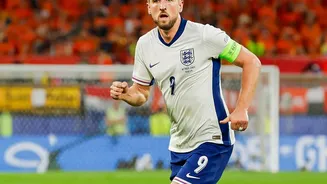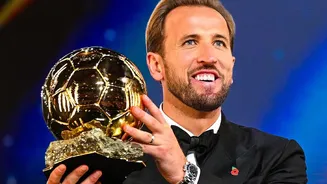




The news is in: Harry Kane has finally captured the 2026 Ballon d'Or. It's a crowning moment for a phenomenal striker. Yet, his win puts him in a club that some of football's most iconic names were never able to join. Here are five legends.
Thierry Henry: The King Who Was Never Crowned
For many Premier
League fans, Thierry Henry is arguably the greatest player of his generation. The Arsenal icon's blend of pace, power, and balletic grace was unstoppable. In the 2002-03 season, he achieved the incredible feat of scoring 24 goals and providing 20 assists in the league. Despite this, he controversially lost the 2003 Ballon d'Or to Juventus midfielder Pavel Nedvěd. Many felt Henry was 'robbed', pointing to his unprecedented statistical output. However, Nedvěd had guided Juventus to a Serie A title and the Champions League final, delivering decisive performances in big European nights, which likely swayed the voters. Henry also finished third in 2006, but his peak years coincided with an era where major tournament success often proved decisive, leaving one of the game's most elegant forwards without its top individual prize.
Paolo Maldini: The Defensive Deity
The Ballon d'Or has always shown a strong bias towards attacking players, and no case proves this more than Paolo Maldini. A one-club man, 'Il Capitano' was the cornerstone of AC Milan's defence for a staggering 25 seasons, winning five Champions League titles and seven Serie A crowns. Maldini was the complete defender: elegant, intelligent, and near-flawless in his timing. He finished third in the Ballon d'Or voting on two separate occasions, in 1994 and 2003. In 1994, he led Italy to a World Cup final and Milan to a dominant Champions League victory, yet was beaten by forwards Hristo Stoichkov and Roberto Baggio. That one of the greatest defenders in history never won is a testament to the award's focus on goalscorers over the art of preventing them.
Andrés Iniesta: The World Cup Hero
In 2010, Andrés Iniesta did something few players ever will: he scored the winning goal in a World Cup final. That alone, combined with his sublime performances for a dominant Barcelona side, made him a huge favourite for the Ballon d'Or. In a move that still sparks debate, the award went to his club teammate, Lionel Messi. It was the first year the award merged with the FIFA World Player of the Year, and the voting criteria seemed to favour individual brilliance over collective, trophy-laden success. Iniesta finished second, with his midfield partner Xavi in third. Even France Football, the award's founding magazine, later published an editorial titled 'Perdón, Andrés' (Sorry, Andrés), acknowledging the 'democratic anomaly' of his loss.
Xavi Hernández: The Puppet Master
If Iniesta was the artist, Xavi was the architect of the all-conquering Barcelona and Spain teams. His ability to dictate the tempo of a game with his relentless, precise passing was revolutionary. He was the metronome of 'tiki-taka', a style that mesmerised the football world. Yet, like his midfield partner, his genius was often overshadowed by the goalscoring exploits of those playing ahead of him. Xavi holds the unfortunate record of finishing third in the Ballon d'Or for three consecutive years: 2009, 2010, and 2011. In each of those years, Lionel Messi took home the prize. Xavi himself has remained philosophical, stating he never felt robbed and that Messi was simply a better individual footballer, but many feel his era-defining influence deserved the ultimate recognition.
Ferenc Puskás: The Galloping Major
A true legend from a bygone era, Ferenc Puskás was the sport's first international superstar and the lethal arrowhead of Hungary's 'Magnificent Magyars' in the 1950s. A prolific goalscorer, he led Real Madrid to three European Cups. In 1960, after scoring four goals in a single European Cup final, he finished as the runner-up for the Ballon d'Or to Barcelona's Luis Suárez. Puskás was a victim of circumstance; the Ballon d'Or was only established in 1956, past the absolute peak of the Hungarian national team that had revolutionised football. Despite a career that saw him score an astonishing number of goals and win a host of titles, the 'Galloping Major' was never officially named the best player in Europe.