






The Shift Worker’s Dilemma
For millennia, human biology has been tied to the rise and fall of the sun. This natural, 24-hour cycle is called the circadian rhythm, and it acts as our body's internal master clock, governing everything from hormone release to body temperature and,
most importantly, our sleep-wake cycle. When morning light hits our eyes, it signals our brain to suppress melatonin—the sleep hormone—and ramp up alertness. As darkness falls, the opposite happens, and rising melatonin levels prepare us for sleep. Shift work throws a wrench in this finely tuned system. By working nights and attempting to sleep during the day, shift workers live in a state of misalignment between their internal clock and the external environment. This conflict, known as shift work sleep disorder, can make it incredibly difficult to fall asleep after a long shift and stay alert when on the job.
Understanding Light's Powerful Signals
Not all light is created equal. The key to its powerful effect on our brain lies in its color temperature, measured in Kelvins (K). Bright, midday sun is packed with blue light, which has a high color temperature (around 5000K-6500K). This blue-rich light is the strongest signal for our brains to stay awake and inhibit melatonin production. This is why looking at phone screens or being under harsh fluorescent office lights in the evening can disrupt sleep. In contrast, the light during a natural sunset transitions to much warmer, red and amber tones, with a very low color temperature (under 3000K). These long-wavelength colors have a minimal effect on melatonin suppression. In essence, blue light acts as a 'go' signal for the brain, while red and amber light act as a 'stop' signal, allowing the body's natural sleep processes to take over.
Mimicking the Sunset to Trick Your Brain
This is where the concept of 'sunset lighting' comes in. It’s a strategy that involves deliberately changing your artificial light environment to replicate the sun's natural transition from day to night, regardless of what time the clock says. The goal is to create a state of what some researchers call “physiological darkness.” Instead of coming home from a night shift and trying to wind down in a brightly lit house, you strategically swap cool, blue-toned lights for warm, dim, amber- or red-hued ones. This change signals to your brain's sensitive photoreceptors that the 'day' is ending. By doing this 60 to 90 minutes before your desired bedtime, you allow your brain to begin its crucial melatonin production, which would otherwise be blocked by exposure to regular indoor lighting or daylight.
Putting It Into Practice
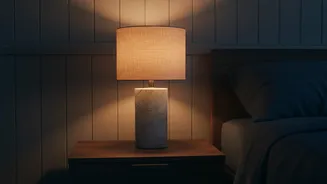
Implementing this strategy doesn't have to be complicated. Start by creating a wind-down routine that focuses on light control. As soon as you get home from a night shift, draw blackout curtains to block as much daylight as possible. Avoid turning on bright overhead lights, especially in the kitchen or bathroom. Instead, use lamps with warm-toned bulbs. Many smart bulbs on the market allow you to easily change the color temperature and brightness from your phone, scheduling them to automatically shift to a deep amber or red. Look for bulbs rated below 2700K for evening use. Additionally, enable 'Night Shift' or equivalent modes on all your digital devices to reduce their blue light emission. For an extra layer of protection, some studies have shown that wearing amber-lensed, blue-light-blocking glasses in the hours before bed can significantly improve sleep quality for shift workers.