


A Barcode of Starlight
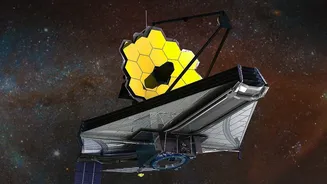
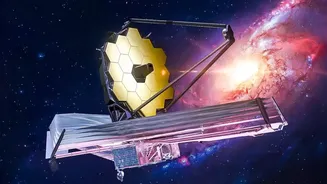
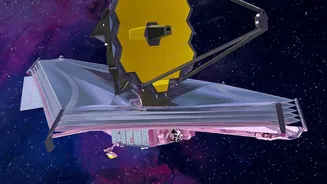
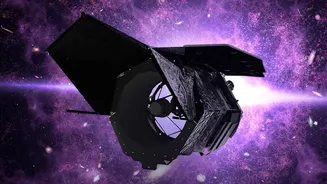
The James Webb Space Telescope is an unparalleled observatory, designed to see the universe in infrared light, which is invisible to the human eye. This capability is crucial for studying exoplanets—planets orbiting other stars. One of its primary methods
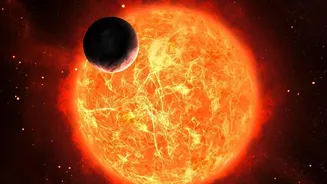
is called transmission spectroscopy. When an exoplanet passes in front of its host star from our point of view, a tiny fraction of the starlight filters through the planet's atmosphere. Gases in that atmosphere absorb specific wavelengths, or colours, of light. This creates a unique chemical fingerprint, like a barcode, that Webb's sensitive instruments can read. By analysing which colours of light are missing, scientists can determine precisely which molecules, like water vapour, methane, or carbon dioxide, are present hundreds of light-years away.
Water: More Than a Sign of Life
Finding water vapour is exciting because all life as we know it depends on water. But for scientists, its presence signifies much more than just the potential for alien oceans. Water vapour is a powerful greenhouse gas. Its existence in an atmosphere provides critical clues about a planet's temperature and climate stability. For a planet to be truly habitable, it needs to maintain a temperature that allows liquid water to persist on its surface for billions of years. Detecting water vapour is the first step in assessing whether a planet has the right ingredients for a stable, long-term climate, rather than being a frozen ice ball or a scorching, evaporated rock. A recent detection of water in the inner, rocky-planet-forming zone of the PDS 70 system suggests some planets may have access to water from the very beginning of their formation.
A Gateway to Biosignatures
The ultimate goal for many astronomers is to find biosignatures—gases that are produced by life. On Earth, for example, oxygen is constantly replenished by photosynthesis, and molecules like methane can be produced by biological processes. The JWST's detection of water, alongside gases like methane and carbon dioxide on exoplanets such as K2-18 b, helps scientists build a complete picture of a planet's atmospheric chemistry. This context is vital. Finding a gas like methane is interesting, but finding it in an atmosphere that also contains water and carbon dioxide makes it a much more compelling candidate for further study. It allows researchers to rule out purely geological or chemical explanations and focus on worlds where the combination of gases hints at something more.
Refining the Search for Another Earth
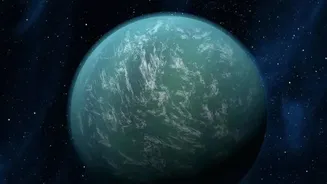
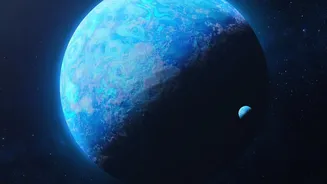
Before the JWST, much of our understanding of exoplanet atmospheres was based on models and limited observations. Webb is providing a reality check, showing that alien worlds are far more diverse and complex than we imagined. Some planets are so-called 'Hycean' worlds, which could have water oceans under hydrogen-rich atmospheres. Others have clouds of vaporised rock. By successfully detecting water on different types of planets—from gas giants like WASP-80 b to potential ocean worlds like K2-18 b—scientists can test and refine their theories about how planets form and evolve. Each detection helps narrow the search for truly Earth-like planets. It allows astronomers to better understand what makes a planet habitable and distinguishes a barren world with trace amounts of water from one that could genuinely support life. This process moves the search from a wide, speculative hunt to a focused, evidence-based investigation.