





1. What Is the Bharatiya Antariksha Station?
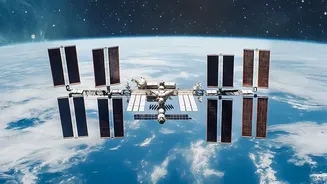
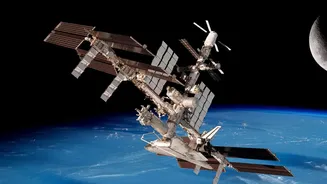
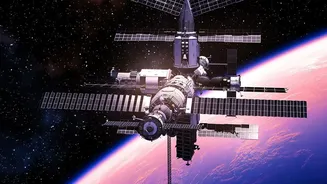
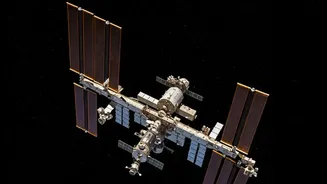
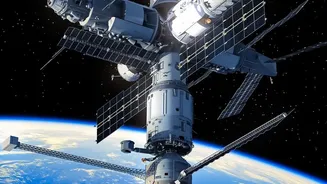
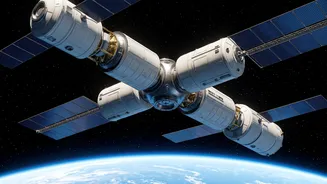
The Bharatiya Antariksha Station (BAS) is a planned modular space station that will be developed and operated by the Indian Space Research Organisation (ISRO). Unlike short spaceflights, the BAS will allow Indian astronauts, known as Gaganyatris, to live
and work in space for extended periods of three to six months. It is designed to orbit Earth at an altitude of approximately 400-450 kilometres. The station will be assembled in space, piece by piece, starting with a foundational module. The final five-module configuration is expected to weigh around 52 tonnes and will be equipped with systems for life support, scientific research, and docking with other spacecraft. It will serve as India's own laboratory in the sky, a crucial piece of infrastructure for long-duration human space missions.
2. When Will It Be Operational?
ISRO is working on a phased timeline for this monumental project. The complete, five-module space station is targeted for full operation by 2035. However, the journey begins much sooner. The first piece, a base module known as BAS-01, is scheduled to be launched into orbit by 2028. This initial module, which received government approval in 2024, will serve as a testbed for crucial technologies. The development and launch of this first module alone are estimated to cost around ₹1,763 crore and will be executed over a four-year window from 2025 to 2028. Subsequent modules will be launched and added over the following years to gradually build up the station's full capabilities.
3. What Will India Do with Its Own Station?
The primary purpose of the Bharatiya Antariksha Station is to conduct scientific research in a microgravity environment, where the effects of gravity are greatly reduced. This unique setting allows for experiments that are impossible to perform on Earth, with potential breakthroughs in fields like medicine, pharmaceuticals, and material sciences. Researchers will study the effects of long-duration spaceflight on the human body, which is vital for planning future deep-space missions. The station will also be a platform for developing and testing new space technologies, fostering innovation, and even creating opportunities for space manufacturing. Furthermore, it will enhance India's Earth observation capabilities for disaster management and resource monitoring.
4. How Does This Fit into India's Broader Space Program?
The space station is the logical next step after the Gaganyaan mission, India's program to send humans to space. Gaganyaan, which aims to launch a crew of three into orbit for a three-day mission, is developing the foundational technologies needed for human spaceflight, such as life support systems, crew escape mechanisms, and reentry vehicles. These capabilities are essential building blocks for the much more complex task of assembling and operating a space station. The experience gained from Gaganyaan will directly feed into the BAS project. The station, in turn, will serve as a crucial bridge for even more ambitious goals, such as sending an Indian astronaut to the Moon by 2040, by allowing ISRO to master rendezvous, docking, and long-duration life support.
5. Why Is This Project So Important for India?
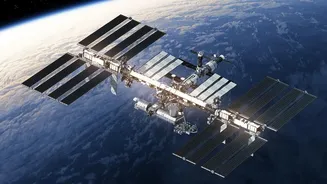
Building and operating a space station is about more than just science; it's a powerful statement of a nation's technological prowess and strategic ambition. When the BAS becomes operational, India will join a very exclusive club of nations with their own space stations, a group that currently only includes the multi-national International Space Station and China's Tiangong. This elevates India's stature in global space politics and diplomacy, allowing it to set rules and form partnerships for the next era of exploration. Economically, the project is expected to spur innovation, create high-tech jobs, and strengthen the domestic aerospace industry. Ultimately, the Bharatiya Antariksha Station represents a shift from executing individual missions to establishing a sustained human presence in orbit, inspiring a new generation and cementing India's place as a major global space power.