
What Exactly is a Quasar?
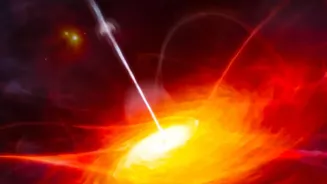
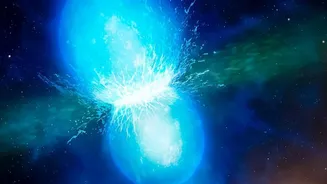
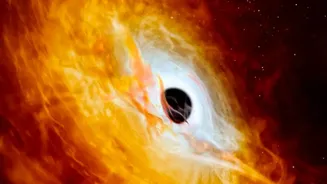
Think of a quasar as the blindingly bright beacon powered by a supermassive black hole. These aren't just any black holes; they are behemoths, millions to billions of times more massive than our sun, sitting at the centres of young galaxies. As they furiously
pull in surrounding gas and dust, the material forms a spinning disk that heats up to millions of degrees from gravitational stress and friction. This process releases an incredible amount of energy, making the quasar so luminous it can outshine its entire host galaxy of billions of stars. Because they are so bright, quasars act as cosmic lighthouses, allowing astronomers to peer back into the very early history of the universe.
A Record-Breaking Discovery
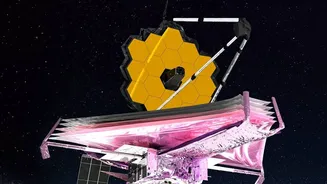
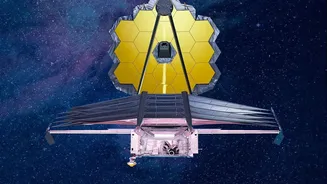
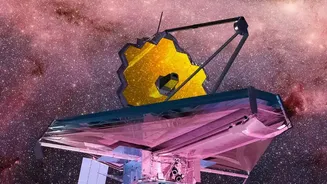
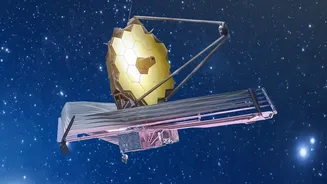
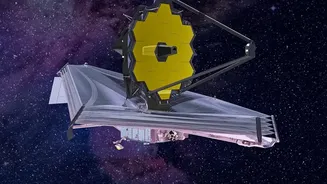
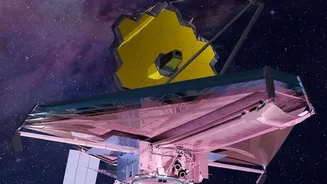
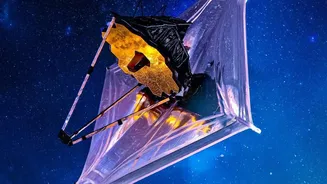
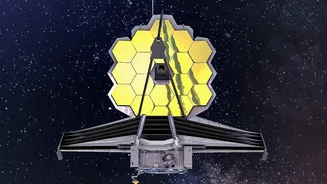
Astronomers using the James Webb Space Telescope (JWST), along with the Gemini North telescope in Hawaiʻi, identified the most distant and oldest compact pair of quasars ever found. Seen as they were just 900 million years after the Big Bang, these twin cosmic engines reside in a system nicknamed Nāpōwawāʻenakaulua. The two supermassive black holes are astonishingly large for their age. One has a mass of about 1.5 billion times that of our sun, while its companion weighs in at around 400 million solar masses. They are also incredibly close to each other in cosmic terms—separated by only 18,100 light-years, a fraction of the size of our own Milky Way galaxy.
The Cosmic 'How?' Question
Finding even one supermassive black hole of this size so early in the universe's history is a major puzzle. Current theories of black hole growth struggle to explain how they could become so massive, so quickly. Black holes are thought to grow by consuming gas and merging with other black holes over vast stretches of time. Finding one weighing 1.5 billion suns when the universe was just a toddler defies conventional models. Finding two of them together, on a collision course, is even more shocking. As lead researcher Silvia Onorato stated, there is currently no definitive theoretical explanation for how even one of these giants could exist so early, let alone two.
A Powerful Clue: Galaxy Mergers
The existence of this quasar pair provides a crucial piece of evidence for a leading theory of rapid black hole growth: galaxy mergers. The two quasars are located in the hearts of two galaxies that are in the process of colliding and merging. Scientists have long theorised that such mergers would funnel enormous amounts of gas toward the central black holes, providing the fuel needed for them to grow at an accelerated rate. This discovery offers a direct snapshot of that process in action during the universe's infancy. It suggests the early cosmos was a chaotic and dynamic place, where frequent galaxy collisions may have been the key to building the first cosmic giants.
Rewriting the First Chapter of the Universe
This finding adds to a growing body of evidence from JWST suggesting that the early universe evolved much faster than we once thought. The presence of such massive, structured objects like Nāpōwawāʻenakaulua suggests that the conditions for rapid growth—dense environments and frequent mergers—were already in place. It serves as a unique laboratory for studying how the first massive galaxies and their central black holes assembled. Each new discovery from JWST pushes the boundaries of our knowledge, forcing astronomers to refine their models of cosmic evolution to account for a universe that grew up in a hurry.