







Beyond Just Finding Planets
For decades, the hunt for exoplanets—planets outside our solar system—was about discovery. Scientists celebrated finding new worlds, adding them to a growing catalogue that now numbers in the thousands. But the James Webb Space Telescope has ushered in a new era:
the age of characterisation. It's no longer enough to know a planet exists; scientists now want to know what it’s like. Is it rocky or gaseous? Hot or cold? And most compellingly, what is its atmosphere made of? This is where the JWST excels, using its powerful infrared instruments to analyse the light that passes through or is emitted from these distant worlds, decoding the secrets of their skies.
The Forecast for a 'Hot Jupiter'
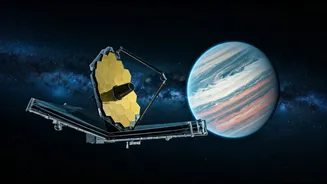
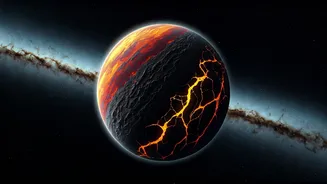
One of the most detailed cosmic weather reports comes from a planet named WASP-43 b, located about 280 light-years away. This world is a type of exoplanet known as a "hot Jupiter." It’s a gas giant similar in size to our own Jupiter, but it orbits its star at an incredibly close distance—completing a full year in just 19.5 hours. This proximity means the planet is tidally locked, with one side perpetually facing the star in permanent daylight and the other shrouded in eternal night. This extreme setup creates a perfect laboratory for studying atmospheric dynamics, and Webb has delivered a stunningly detailed forecast.
Today's Alien Weather: Scorching Days and Cloudy Nights
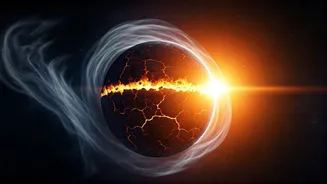
By observing WASP-43 b for a full orbit, Webb’s MIRI (Mid-Infrared Instrument) created a temperature map of the planet. The dayside sizzles at a staggering 1,250 degrees Celsius, hot enough to vaporise rock. The nightside, while never seeing the sun, is still a fiery 600 degrees Celsius. This is much warmer than it would be without an atmosphere, proving that powerful winds are at play. Scientists estimate these equatorial winds whip around the planet at speeds of 5,000 miles per hour, dragging heat from the scorching dayside to the dark nightside. The weather report also calls for clear skies on the dayside, but the nightside is likely covered in a thick blanket of high clouds, which trap heat and prevent the nightside from cooling further. These aren't water clouds like on Earth, but likely composed of minerals and other compounds that can condense in the extreme heat.
The Surprising Case of Missing Methane
Webb's analysis also revealed a chemical puzzle. The data showed clear signs of water vapour across the planet, but there was a surprising lack of methane. On the brutally hot dayside, methane isn't expected to survive. However, based on the cooler temperatures of the nightside, scientists predicted methane should be stable and detectable there. Its absence suggests that the planet's ferocious, high-speed winds are mixing the atmosphere so thoroughly and rapidly that the air doesn't have time to reach chemical equilibrium. Gases from the dayside are violently churned to the nightside and back again before methane molecules can form in significant amounts, a testament to the planet's extreme climate.
A Glimpse of Our Own Future?
While studying hot Jupiters provides insight into planetary extremes, recent JWST observations from July 2026 have also offered a glimpse into the distant future of our own solar system. The telescope studied WD 1856 b, a Jupiter-sized planet orbiting a white dwarf—the tiny, dense remnant of a dead Sun-like star. The star would have destroyed any close-orbiting planets during its death throes, yet this planet survived and now orbits its dead star every 34 hours. By detecting methane and hydrocarbons in its atmosphere, Webb confirmed for the first time that atmospheres can exist on planets orbiting dead stars. This research helps scientists understand how planetary systems evolve and what might become of giants like Jupiter billions of years from now.