






The Air Locked Beneath Their Feet
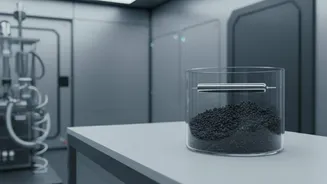
To the naked eye, moon dust, or regolith, is a seemingly lifeless grey powder. But chemically, it's a treasure chest. Lunar regolith is composed of about 45% oxygen by weight. The catch is that this oxygen isn't free-floating gas; it is chemically bonded
with various metals and silicon to form oxides. These are the same kinds of rock-forming minerals found on Earth, but they have been pulverized by billions of years of meteorite impacts in the Moon's vacuum environment. The challenge for NASA and its partners isn't finding oxygen, but rather breaking these powerful chemical bonds to release it. The process of harvesting local materials is known as in-situ resource utilization, or ISRU, and it's considered the foundational technology for making human exploration of the solar system sustainable.
An Oven for the Moon
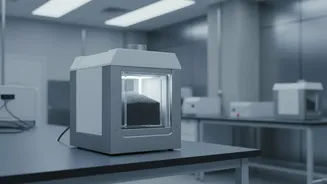
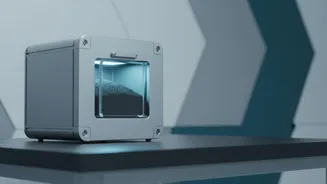
Several methods are being developed to liberate this trapped oxygen, but two leading techniques are Molten Oxide Electrolysis (MRE) and Carbothermal Reduction. MRE works by melting the lunar regolith at extreme temperatures, around 1,600°C, and then passing an electric current through the molten soil. This process, called electrolysis, splits the metal oxides into pure, breathable oxygen gas at one electrode and molten metal alloys at the other. Carbothermal Reduction also uses very high temperatures but introduces a carbon source, like methane, into the reactor. The carbon effectively steals the oxygen from the metal oxides, producing carbon monoxide gas. This gas is then processed in a second step to release the oxygen. In recent tests for its Carbothermal Reduction Demonstration (CaRD) project, NASA successfully used concentrated solar energy to power the reaction, confirming that sunlight alone could drive the chemical process on the Moon.
More Than Just Breathing
While breathable air is the most obvious benefit, the vast quantities of oxygen that could be produced have a much larger implication: rocket fuel. Liquid oxygen (LOX) is the primary oxidizer used in most modern rocket engines, making up the vast majority of the propellant's mass. The ability to manufacture LOX on the Moon would transform the lunar surface from a destination into a deep-space refueling station. Missions leaving Earth could launch with only the fuel needed to get to the Moon, top up their tanks, and then venture farther out to Mars and beyond. This dramatically reduces the mass that needs to be lifted out of Earth's heavy gravity, which in turn slashes mission complexity and cost.
The Business Case for a Moon Base
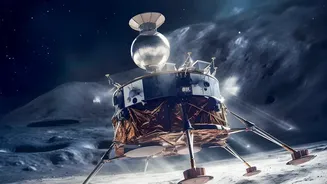
The economics of space exploration are brutal. Every kilogram of mass launched from Earth to the Moon costs an immense amount of money. Relying solely on Earth-based resupply missions makes a permanent, thriving lunar base an economic fantasy. ISRU changes this calculation entirely. By producing life support consumables and rocket propellant on-site, the Artemis program's goal of a sustainable lunar presence becomes viable. Companies like Sierra Space are partnering with NASA to develop and test these oxygen-extraction reactors. Success would not only support NASA's goals but also create a new lunar economy, where oxygen could be sold as a commodity to other national agencies or private space-faring companies. The byproducts, such as silicon and metals from electrolysis, could even be used to manufacture solar panels or construct habitats.