



The Starlight Sieve Technique
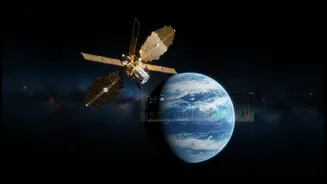
The primary method scientists use is called transmission spectroscopy. Imagine an exoplanet, hundreds of light-years away, passing in front of its host star from our point of view. As the starlight travels through the planet's atmosphere, some of that
light is absorbed by the gases present. Different molecules act like tiny sieves, catching very specific colours, or wavelengths, of light. This filtering process imprints a chemical fingerprint onto the starlight that reaches our telescopes. By analysing which wavelengths are missing, astronomers can deduce what the planet's atmosphere is made of.
Reading a Chemical Barcode
Every molecule, from oxygen to methane, has a unique absorption pattern, like a chemical barcode. Water (H2O) has a particularly strong and recognisable signature in the infrared part of the spectrum. This is where an observatory like the James Webb Space Telescope (JWST) excels. Its powerful instruments, like the Near-Infrared Spectrograph (NIRSpec), are specifically designed to capture this infrared light with incredible precision. When JWST observes an exoplanet transit, it spreads the incoming starlight into a rainbow, or spectrum. Dips and wiggles in this spectrum show exactly where light has been absorbed, revealing the presence and even the abundance of water vapour.
From Presence to Profile
Detecting water is just the first step. The real breakthrough is in creating a 'water vapour profile'. This isn't a picture in the traditional sense, but a data-driven model showing how water is distributed throughout the atmosphere. By looking at the fine details of water's absorption lines, scientists can infer properties like temperature and pressure. For example, the way the absorption signature looks might indicate that water vapour is concentrated at lower, warmer altitudes, or perhaps it's more spread out. This gives us a vertical map of water in the alien sky, a crucial piece of the puzzle.
Inferring an Active Cycle
So how do scientists make the leap from a vapour profile to an 'active water cycle'? It’s a process of inference. On a planet with a water cycle, water doesn't just sit there; it evaporates, forms clouds, and precipitates. A uniform distribution of water vapour would suggest a static, well-mixed atmosphere. However, if a telescope's data suggests water is concentrated in some layers but absent in others, it strongly implies that atmospheric processes are at work. For instance, an absence of water vapour at high altitudes might mean it has condensed and formed clouds lower down. On tidally locked 'hot Jupiter' planets, astronomers have even been able to contrast the hot dayside, where water molecules are ripped apart, with the cooler nightside, where they recombine, indicating a dynamic, planet-circling water cycle.
Challenges and the Next Frontier
This work is not without its challenges. Thick clouds can obscure the atmosphere, hiding water from view entirely. Furthermore, the signals are incredibly faint, and it takes multiple observations to confirm a detection. Sometimes, what looks like water from a planet's atmosphere could even be a false positive caused by large, cool starspots on the host star's surface. Despite these hurdles, the goal is clear. By building a catalogue of exoplanets with detailed water profiles, scientists can begin to understand which worlds have the right conditions—including an active water cycle—to support liquid water on their surface, the ultimate prerequisite for life as we know it.