




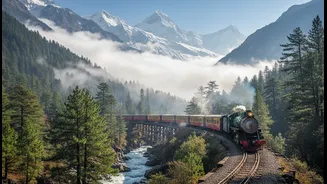



Darjeeling Himalayan Railway: The Original Toy Train
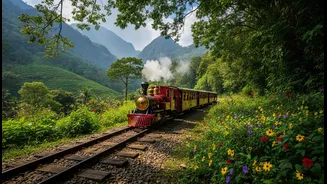
A journey on the Darjeeling Himalayan Railway (DHR) is a step back in time. This narrow-gauge railway, lovingly called the 'Toy Train', was built between 1879 and 1881 and has been a UNESCO World Heritage site since 1999. The 88-kilometre route chugs
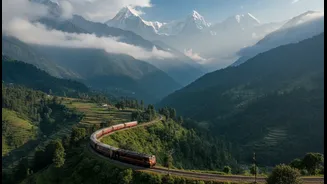
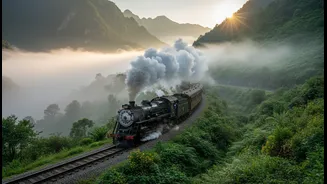
from New Jalpaiguri to Darjeeling, climbing from 100 metres to over 2,200 metres in altitude. Passengers are treated to breathtaking views of emerald tea plantations and the snow-capped Kanchenjunga peak. The train navigates sharp curves, five loops, and six zig-zags to gain height, with the Batasia Loop being a famous highlight, offering a panoramic view of Darjeeling town against the Himalayan backdrop. The vintage steam locomotives, some built between 1889 and 1925, add to the nostalgic charm of this engineering marvel.
Kalka-Shimla Railway: A Himalayan Marvel
Another gem in the UNESCO-listed Mountain Railways of India, the Kalka-Shimla Railway offers a spectacular 96-kilometre journey to Shimla, the former summer capital of British India. Built between 1898 and 1903, this line is a testament to engineering grit, featuring 102 active tunnels, over 864 bridges and viaducts, and 919 curves. The five-hour trip winds through pine forests and picturesque valleys of the Shivalik hills, offering a serene escape. One of the most famous points is the Barog tunnel (No. 33), the longest on the route at 1,143 metres, which has a poignant story attached to its construction. The slow pace of the train allows travellers to fully absorb the stunning landscapes, making it one of the most beloved hill journeys in the country.
Nilgiri Mountain Railway: Steepest in Asia
Journeying through the misty Nilgiri Hills, or 'Blue Mountains', of Tamil Nadu, this railway is a marvel of its own. Designated a UNESCO World Heritage site in 2005, the line from Mettupalayam to Ooty is renowned for having the steepest gradient in all of Asia. To conquer the incline, it uses a unique 'rack and pinion' system, where a cogwheel engages with a toothed rail between the tracks, a feature not found on other Indian lines. The 46-kilometre journey takes about five hours, passing through 16 tunnels, 250 bridges, and 208 sharp curves. The route offers spectacular views of dense forests, lush tea plantations, and cascading ravines, with vintage steam locomotives operating on the steepest sections, completing the magical experience.
Konkan Railway: A Coastal Spectacle
A more modern engineering triumph, the Konkan Railway connects India's western coast, stretching over 740 kilometres from Maharashtra through Goa to Karnataka. Completed in 1998, this route is a feast for the eyes, especially during the monsoon season. The journey presents a stunning panorama of the Sahyadri mountains on one side and the sparkling Arabian Sea on the other. The line navigates through over 90 tunnels and across more than 2,000 bridges, including the Panvalnadi bridge, once India's highest viaduct. Passengers are treated to views of lush green fields, thick forests, gushing waterfalls, and charming villages, making it one of the most scenic coastal journeys in the world.
Pamban Bridge: A Ride Over the Sea
For a truly unique and thrilling experience, the train journey to Rameswaram Island in Tamil Nadu is unparalleled. The highlight is crossing the Pamban Bridge, India's first sea bridge, which opened in 1914. This 2-kilometre-long cantilever railway bridge connects the mainland to the island, offering passengers the incredible feeling of riding just metres above the clear blue waters of the Palk Strait. As the train slows down to cross the bridge, travellers are gifted with uninterrupted panoramic views of the ocean. The structure itself is an engineering marvel, featuring a bascule section that can lift to allow ships to pass underneath. Though rail services have been temporarily suspended for reconstruction, the experience remains an iconic part of India's railway lore.