





What is Aphelion, Exactly?
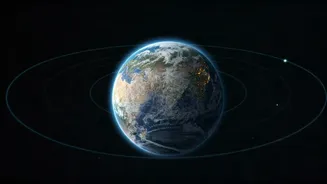
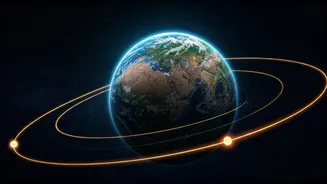
Let’s break down the word. 'Aphelion' comes from ancient Greek, where 'apo' means far and 'helios' means sun. So, aphelion is simply the point in Earth's orbit where it is most distant from the sun. Think of Earth’s orbit as a slightly squashed circle,
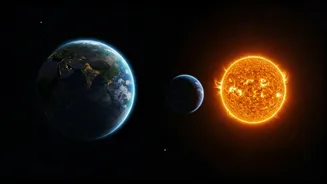
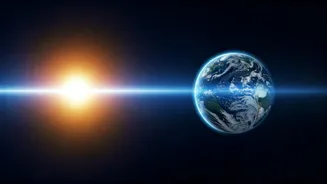
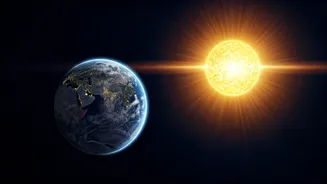
or an ellipse. Because it’s not perfectly round, there’s a point where we are closest and a point where we are farthest. The closest point, which happens in early January, is called 'perihelion' ('peri' means near). On July 6, 2026, Earth will be at aphelion, about 152.1 million kilometers from the sun. That’s roughly 5 million kilometers farther than at perihelion.
The Biggest Misconception: Farthest Means Colder, Right?
This is a very logical assumption, but it's incorrect. Aphelion happens in early July, right in the middle of summer for the Northern Hemisphere. If distance alone dictated temperature, July should be our coldest month. The real reason for the seasons is Earth's axial tilt. Our planet is tilted on its axis by about 23.5 degrees. This tilt means that during June and July, the Northern Hemisphere is angled towards the sun, receiving more direct sunlight for longer periods. This direct energy is what heats us up and creates summer. Meanwhile, the Southern Hemisphere is tilted away, experiencing winter. The 5-million-kilometer difference in distance is too small to overcome the massive effect of this direct sunlight.
So, Does Aphelion Have Any Effect At All?
Yes, but the effects are very subtle. One interesting consequence relates to the speed of our planet. According to Kepler's laws of planetary motion, a planet moves slowest when it's farthest from the star it orbits. This means Earth is moving at its most sluggish pace around the time of aphelion. Because this slowdown happens during the Northern Hemisphere's summer, it actually makes our summer the longest of the four seasons, by nearly five days. Conversely, the Southern Hemisphere's winter is its longest season. At aphelion, the Earth also receives slightly less solar energy—about 7% less than at perihelion—but again, this is a minor effect compared to the directness of the sun's rays from our axial tilt.
A Cosmic Reminder in Our Skies
You can't go outside and 'see' aphelion. There is no visible sign in the sky, and you certainly won't feel a change in temperature. The sun will not look noticeably smaller. Aphelion is not a dramatic event but a quiet, annual milestone in our planet's celestial mechanics. It’s a great reminder that the universe operates on principles that are often counter-intuitive. It challenges our simple assumptions and invites us to look deeper into the physics that governs our world, from the grand dance of planets to the subtle tilt that gives us our seasons. It highlights that our home is part of a dynamic system, constantly in motion.