


A New Window on Cosmic Birth
Astronomers are calling it a game-changer. Using its powerful infrared instruments, the James Webb Space Telescope (JWST) has peered into stellar nurseries that were previously hidden from view. One of the most stunning examples is an object known as Herbig-Haro
212 (HH 212), located about 1,300 light-years away in the constellation Orion. While scientists have studied this region for three decades, the new images from Webb are about ten times sharper than any previous views. They reveal a protostar—a star in its infancy—that is estimated to be no more than 50,000 years old. For comparison, our own Sun is a middle-aged 4.6 billion years old. The images show not the star itself, which is hidden by a dense disk of gas and dust, but the dramatic effects of its birth.
Jets, Shocks, and Building Blocks
What the JWST images of objects like HH 212 and L1527 document is a process of both creation and expulsion. At the center, a baby star is furiously gathering mass from a surrounding rotating disk of gas and dust, known as an accretion disk. This disk, which for L1527 is about the size of our solar system, is where planets will eventually form. As the central protostar spins, it throws off enormous, symmetrical jets of material from its poles. These jets, which appear as fiery red plumes in the infrared images, slam into the surrounding interstellar gas at high speeds, creating glowing shockwaves. This violent outflow is a crucial part of star formation, as it carries away excess angular momentum that would otherwise cause the rapidly spinning protostar to tear itself apart.
The Power of Infrared Vision
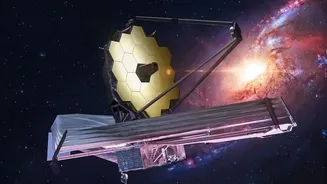
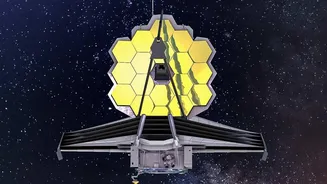
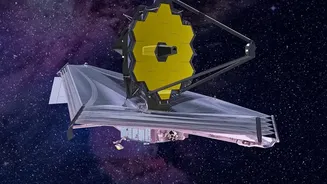
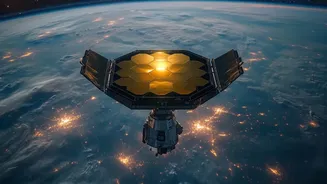
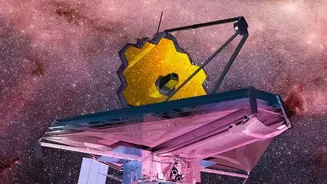
Seeing these cosmic nurseries is a feat only possible because of the JWST's specific design. Star formation happens deep inside vast, cold clouds of gas and dust that are opaque to visible light telescopes like Hubble. Protostars themselves are not yet hot enough to ignite nuclear fusion; instead, they glow from the heat generated by gravitational collapse. This glow, along with the light from shock-heated gas, is emitted primarily at infrared wavelengths. The JWST's massive mirror and sensitive instruments were engineered specifically to capture this infrared light, allowing it to see through the obscuring dust and witness these processes directly for the first time. It's like having a pair of cosmic infrared goggles that can peer into the universe's most hidden corners.
Clues to Our Own Solar System
Beyond their stunning beauty, these images are a scientific treasure trove because they provide a direct look at the conditions that likely shaped our own solar system. By studying the structure of the jets, the composition of the gas, and the clumping of material within the accretion disks of young stars, scientists can refine their models of planetary formation. Each observation of a protostar, whether it's HH 212, L1527, or others in regions like the Taurus star-forming region, adds another piece to the puzzle of how a chaotic cloud of dust and gas evolves into a stable system of planets orbiting a star. In essence, the James Webb Space Telescope is providing a blueprint for how suns and worlds are made, allowing us to see a reflection of our own cosmic infancy billions of years ago.