




The Universe's Ultimate Speed Limit
Everything comes down to one simple, mind-bending fact: light, while incredibly fast, does not travel instantaneously. In the vacuum of space, light zips along at approximately 300,000 kilometers per second (about 186,000 miles per second). At this speed,
a beam of light could circle the Earth more than seven times in a single second. It's the absolute fastest that anything can travel in the universe, a cosmic speed limit that nothing can break. On human scales, this seems immediate. But the universe is built on a scale that defies human intuition. The distances between stars are so immense that even at this breakneck pace, light requires a significant amount of time to travel from one point to another.
Measuring Space with Time
Because kilometers and miles become unwieldy when dealing with cosmic distances, astronomers use a more convenient unit: the light-year. Despite its name, a light-year is a measure of distance, not time. It is defined as the distance that light travels in one Julian year—roughly 9.46 trillion kilometers (about 5.88 trillion miles). Using this metric makes it easier to comprehend the vastness of space. If a star is one light-year away, the light we see from it tonight began its journey one year ago. This simple conversion turns the concept of distance into a relatable measure of time, helping us understand the age of the light reaching our eyes.
Postcards From Our Cosmic Neighbours
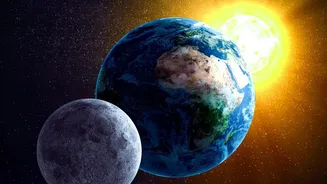
Let's put this into perspective. Even within our own solar system, there are delays. The light from our Sun doesn't reach us instantly; it takes about 8 minutes and 20 seconds to travel the 150 million kilometers to Earth. So, if the Sun were to suddenly vanish, we wouldn't know about it for over eight minutes. Our nearest stellar neighbour after the Sun, Proxima Centauri, is about 4.2 light-years away. The light we see from it tonight left the star more than four years ago. The North Star, Polaris, is much farther, with its light taking around 430 to 447 years to reach us depending on the latest measurements. When you look at it, you are seeing light that started its journey during the 16th or 17th century.
A Telescope Is a Time Machine
This effect becomes even more dramatic when we look beyond our immediate galactic neighbourhood. The Andromeda Galaxy is the closest major galaxy to our own Milky Way and is visible to the naked eye as a faint, fuzzy patch. It is approximately 2.5 million light-years away. This means the light hitting your retina left Andromeda 2.5 million years ago, long before modern humans walked the Earth. In this sense, every telescope is a time machine. The farther astronomers peer into space, the further back in time they are looking. This allows them to see galaxies as they were billions of years ago, providing invaluable clues about the formation and evolution of the early universe.
What It Means for Stargazing
The finite speed of light adds a profound layer of meaning to stargazing. It means that the night sky is not a static snapshot of the present, but a dynamic collage of the past. Every star is a historical record, showing us what it looked like years, centuries, or millennia ago. It also raises a fascinating possibility: some of the stars we see in the sky may have already burned out or exploded in a supernova. If a star 1,000 light-years away went dark today, we would continue to see its light shining brightly for another 1,000 years, blissfully unaware of its demise until the final photons complete their long voyage to Earth.