
The Ultimate Souvenir: A Round Trip to the Moon
While Chandrayaan-3 was a monumental achievement in landing technology, Chandrayaan-4 represents a quantum leap in complexity. The primary objective is no longer just to get there; it's to get there, collect samples, and come back. This sample-return
capability is the ultimate test of deep-space engineering. If successful, India will join an exclusive club of nations—after the United States, the former Soviet Union, and China—that have accomplished this feat. The mission aims to collect soil and rock samples from the lunar surface and subsurface near the south pole, a region of immense scientific interest for its potential water ice deposits. These pristine samples, returned to labs on Earth, could unlock secrets about the Moon's origin, its geology, and its resource potential for future exploration.
An Engineering Symphony in Five Parts
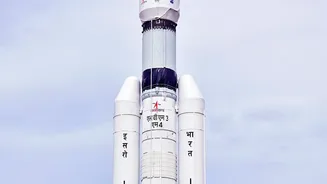
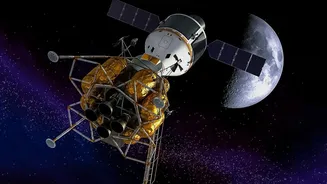
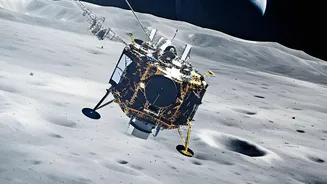
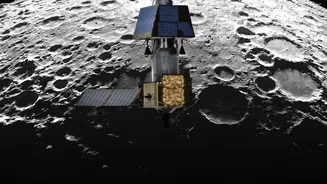
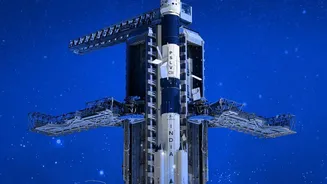
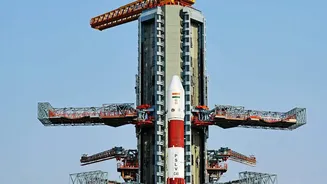
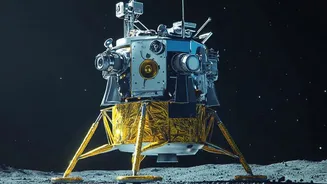
Chandrayaan-4 is not a single spacecraft but a complex, multi-part system, making it ISRO’s most intricate mission to date. Unlike its predecessor, which had three main components, Chandrayaan-4 is composed of five distinct modules: a Propulsion Module to travel to the Moon, a Descender Module to land, an Ascender Module to lift off from the lunar surface, a Transfer Module to carry the samples in orbit, and a Re-entry Module to bring them safely back to Earth. The sheer mass of this combined hardware, estimated to be over 9,000 kilograms, is too heavy for a single launch on India’s most powerful rocket, the LVM3. Consequently, ISRO plans to launch the mission in two separate parts. These two stacks will then need to find each other and dock in Earth's orbit—a critical maneuver that ISRO has been practicing with precursor missions.
The Toughest Claw Game in the Universe
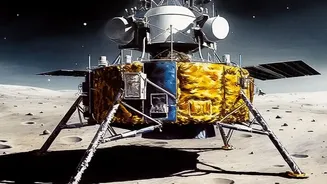
Once on the lunar surface, the mission's next great challenge begins. The lander will deploy a sophisticated robotic arm and a drilling mechanism. This isn't just a simple scoop. The system must be capable of collecting both surface regolith and drilling to access subsurface material, which may hold preserved volatiles like water ice. These samples must then be carefully transferred and sealed into containers aboard the Ascender Module. This entire process must be conducted autonomously in the harsh lunar environment, with its abrasive dust, extreme temperatures, and low gravity. The precision required to operate the robotics, select valuable samples, and ensure they are sealed without contamination for the long journey home sets a new benchmark for ISRO's automation and remote operation capabilities.
Launching Off World: A New Frontier
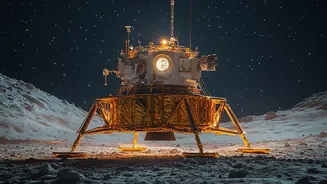
Perhaps the most dramatic phase of the mission is leaving the Moon. After the samples are secured, the Ascender Module will use the Descender as a launchpad and fire its engines to lift off from the lunar surface. This will be the first time an Indian spacecraft has launched from another celestial body. The Ascender must then navigate into lunar orbit to rendezvous and dock with the waiting Transfer Module. This orbital ballet, happening hundreds of thousands of kilometres from home, is a high-stakes operation where failure is not an option. Once docked, the sample container will be transferred to the Re-entry Module. These docking capabilities are not just for this mission; they are fundamental building blocks for India's future human spaceflight program, including a planned crewed lunar landing.
The Final Hurdle: A High-Speed Earth Return
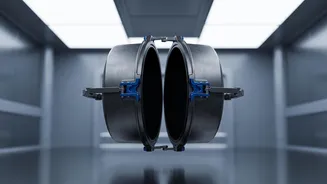
With the precious lunar cargo secured, the Transfer Module will fire its engines to begin the journey back to Earth. The final, fiery challenge is atmospheric re-entry. The Re-entry Module, carrying the samples, will separate and plummet towards Earth at blistering speeds. It must be robust enough to withstand the immense heat and pressure of this descent, protecting its contents before deploying parachutes for a safe splashdown. This controlled, high-speed re-entry is another technology that ISRO must perfect, proving its ability to return not just hardware, but potentially astronauts, safely from deep space in the future. Each step of this complex mission, from its dual-launch strategy to its off-world lift-off, represents a significant escalation of ISRO's engineering prowess.