
A 'New Star' Challenges Old Ideas
When the mysterious object appeared in the constellation Ophiuchus, the 'Serpent-Bearer', it was a time of great debate in astronomy. The prevailing Aristotelian view held that the heavens beyond the Moon were perfect and unchanging. However, this 'new
star', or 'stella nova', showed no detectable parallax, meaning it had to be far beyond the Moon, in the realm of the so-called 'fixed stars'. This directly challenged the old model of the cosmos. While many observed the event, it was German astronomer Johannes Kepler whose detailed study, published in his book 'De Stella Nova', earned the phenomenon its name. For 18 months, the star was visible to the naked eye, even during the day at its peak, before fading from view.
The Anatomy of a Cosmic Explosion
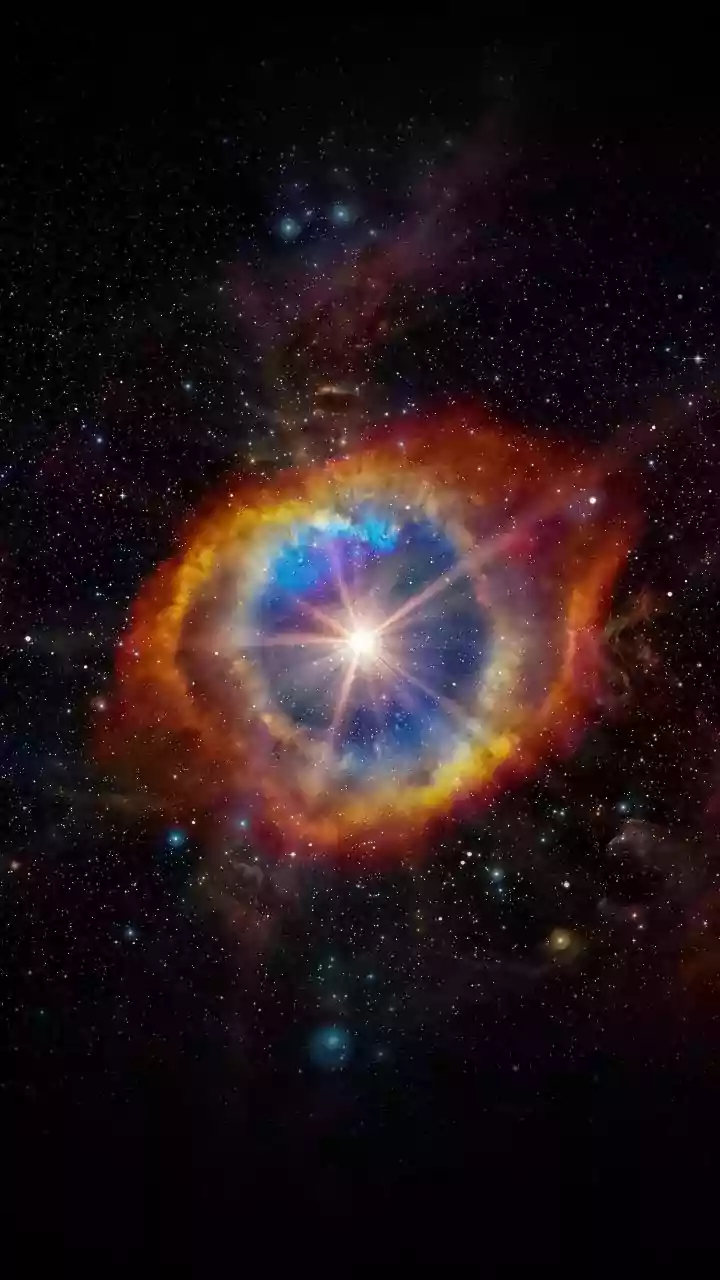
What Kepler and his contemporaries witnessed was not the birth of a star, but its violent death. Scientists now classify SN 1604 as a Type Ia supernova. This specific type of explosion occurs in a binary star system, where two stars orbit each other. One of the stars is a white dwarf — the small, dense core left behind by a star like our Sun. The white dwarf's powerful gravity pulls material from its companion star. When the white dwarf accumulates too much mass, it reaches a critical point, triggering a runaway thermonuclear explosion that tears it apart. These events are incredibly powerful and are responsible for creating and scattering heavy elements, like iron, throughout the galaxy.
From a Point of Light to a Cosmic Cloud
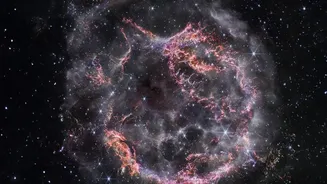
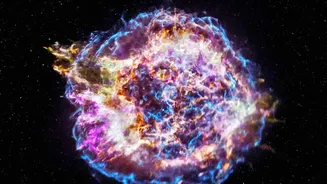
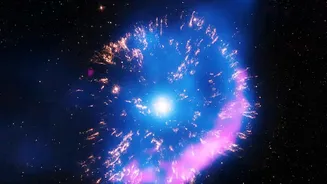
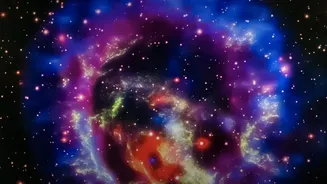
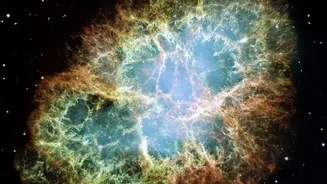
Today, some 20,000 light-years from Earth, the aftermath of that explosion continues to expand outwards. What remains is a beautiful, complex structure known as a supernova remnant. This bubble-shaped cloud of gas and dust is about 14 light-years wide and is expanding at a staggering four million miles per hour. While invisible to the naked eye now, astronomers can explore this remnant using powerful modern instruments. NASA's Great Observatories — the Hubble Space Telescope, the Chandra X-ray Observatory, and the Spitzer Space Telescope — have all been used to study the object in different wavelengths of light, each revealing a different piece of the puzzle.
A Multi-Wavelength Detective Story
By combining data from these telescopes, scientists can create a composite image that tells a more complete story. The Chandra X-ray Observatory detects the hottest parts of the remnant, including extremely high-energy gas from the initial shockwave. Hubble, observing in visible light, sees the densest knots of ejected material where the shockwave is slamming into surrounding interstellar gas. Finally, Spitzer's infrared view reveals microscopic dust particles that were heated by the explosion. Together, these different views show a fast-moving shell rich in iron, surrounded by the expanding shock wave that is sweeping up and energising gas and dust in its path.
Cosmic Mysteries Still Unfolding
Despite over four centuries of observation, Kepler's Supernova still holds mysteries. One of the biggest questions is the nature of the progenitor system. While scientists are confident it was a Type Ia explosion, the exact circumstances are debated. One scenario involves a white dwarf pulling material from a normal companion star, which should have survived the blast. However, despite deep searches, no such surviving star has been found. This has led to an alternative theory: the explosion could have been the result of two white dwarfs merging. The evidence of nitrogen-rich material around the remnant complicates the picture, suggesting a companion star was indeed present, making this a unique object for studying how these supernovas occur.