







A Flicker in the Dark
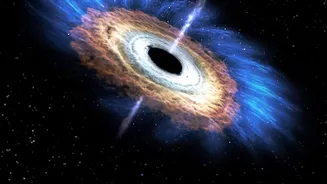
Imagine trying to understand a whirlpool by watching the ripples on the surface. For astrophysicists, studying black holes presents a similar challenge. The black hole itself is invisible, but the material swirling around it, known as an accretion disk,
shines brightly before it disappears forever. A recent study, synthesising over a decade of observations, has honed in on the rapid and seemingly chaotic fluctuations in X-ray emissions coming from the very brink of a supermassive black hole. These are not random flickers; instead, they contain a rhythm, a pattern that scientists have long sought as a key to unlocking the physics of extreme gravity.
The Point of No Return
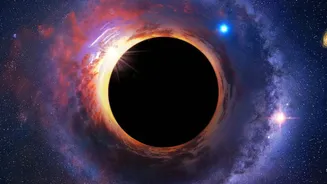
The event horizon is the defining feature of a black hole—an invisible boundary where gravity becomes so powerful that nothing, not even light, can escape. Because it emits no light, it cannot be seen directly. For decades, its properties could only be described by the mathematics of Albert Einstein's theory of general relativity. Any information about the black hole's mass, spin, or charge is thought to be encoded in the behaviour of spacetime at this boundary. Scientists have theorised that as matter spirals towards the event horizon, it should wobble at a specific frequency, a phenomenon known as a quasi-periodic oscillation (QPO). Finding and measuring these oscillations has been a holy grail for astronomers, as it provides a way to 'see' the unseeable by observing its direct influence on the surrounding matter.
A Decade of Data
Finding such a faint, rhythmic signal requires an immense amount of data collected over a very long time. Just as one might listen to hours of static to find a faint radio station, astronomers used observatories like NASA's Chandra X-ray Observatory to stare at black hole systems for years. One such subject of intense, decade-long scrutiny has been the blazar OJ 287, a rare object with two supermassive black holes in its core, located four billion light-years away. By combining observations from dozens of telescopes, an international team of scientists created the most detailed timeline of its brightness and colour changes ever assembled. This painstaking work allowed them to filter out the noise and isolate the subtle, repeating patterns in the X-ray emissions originating from just outside the event horizon.
Decoding the Cosmic Hum
The fluctuating emissions are essentially a 'hum' from the edge of spacetime. The models predict that the frequency of this hum is directly tied to the black hole's fundamental properties. For instance, the way spacetime itself is twisted by a spinning black hole—an effect called frame-dragging—should influence the rhythm of the infalling gas. By matching the observed oscillations with theoretical models, scientists can confirm predictions of general relativity in the most extreme environment in the universe. More than just a confirmation, these signals act as a new diagnostic tool, allowing researchers to measure a black hole's spin and the precise geometry of spacetime near its event horizon. It’s the closest we’ve come to placing a probe right at the edge of infinity.
The Future of Black Hole Astronomy
This breakthrough is more than just an affirmation of an old theory; it opens a new chapter in observational astronomy. For a long time, the properties of event horizons were purely theoretical. The first direct image of a black hole's shadow by the Event Horizon Telescope gave us a visual, and now, the analysis of these fluctuating emissions provides an auditory-like clue. This new ability to probe the near-horizon region allows for sharper tests of gravity and could reveal new physics. As our telescopes become more sensitive and our data analysis techniques more sophisticated, astronomers will be listening for these cosmic hums from across the universe, turning the silent, dark voids of space into objects we can measure, characterise, and ultimately, understand.