


Day vs. Year: A Quick Refresher
Before diving into the Venusian puzzle, let's clarify our terms using Earth as a guide. A 'day' is the time it takes for a planet to complete one full rotation on its axis. For Earth, this is roughly 24 hours. A 'year' is the time it takes for a planet to complete one full orbit
around the Sun. For us, that's approximately 365 days. [4] This simple relationship—many days fitting into one year—is the standard for most planets, which makes Venus's situation all the more extraordinary.
Venus's Bizarre Clock
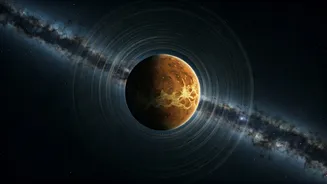
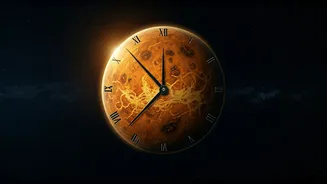
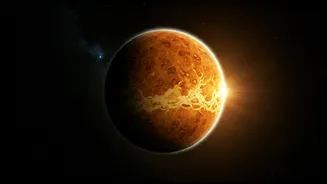
Now, let's look at Venus. It takes about 225 Earth days for Venus to complete one orbit around the Sun, making its year shorter than ours. [4] However, it takes a staggering 243 Earth days for Venus to complete a single rotation on its axis. [3, 8] This means that a Venusian 'sidereal day' (one full rotation) is 18 Earth days longer than its year. [10, 11] If you could stand on its surface, you would live through an entire year before a single day had finished. This is a unique feature in our solar system and turns our Earth-based understanding of time completely on its head.
A Tale of Two Days
To add another layer of complexity, astronomers use two definitions of a day. A 'sidereal day' is one full 360-degree rotation relative to distant stars. [15] For Venus, this is the 243-Earth-day period. But a 'solar day'—the time from one sunrise to the next—is different. [15] Because Venus rotates backwards on its axis very slowly as it orbits the sun, its solar day is much shorter than its sidereal day, coming in at around 117 Earth days. [2, 10] So while the planet itself takes 243 days to spin once, an observer on the surface would see the sun rise and set roughly twice per Venusian year. [12]
The Slow, Backward Spin
The core reason for this temporal weirdness is Venus's incredibly slow and retrograde (backward) rotation. [3] Unlike most other planets in the solar system, which spin counter-clockwise, Venus spins clockwise. [11] If you were on Venus, you'd see the Sun rise in the west and set in the east. [3] This, combined with the incredibly slow speed, creates the unusual relationship between its day and year. But why is Venus so different?
Why So Slow and Backwards?
Scientists do not have a single, definitive answer, but there are several compelling theories. One leading hypothesis is that Venus suffered a cataclysmic impact with a massive object, perhaps a planet-sized body, early in the solar system's history. [7, 18, 19] Such a collision could have dramatically altered its spin, slowing it down or even flipping it upside down, resulting in its current retrograde motion. Another prominent theory points to Venus's incredibly thick and heavy atmosphere. [14, 21] It's thought that solar heating creates powerful atmospheric tides that drag on the planet's surface. Over billions of years, this atmospheric friction could have acted as a brake, slowing Venus's rotation to its present crawl and possibly even reversing it. [13, 14, 23]
A Truly Alien World
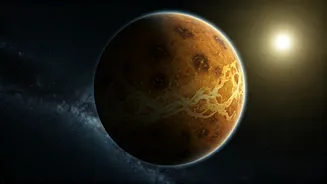
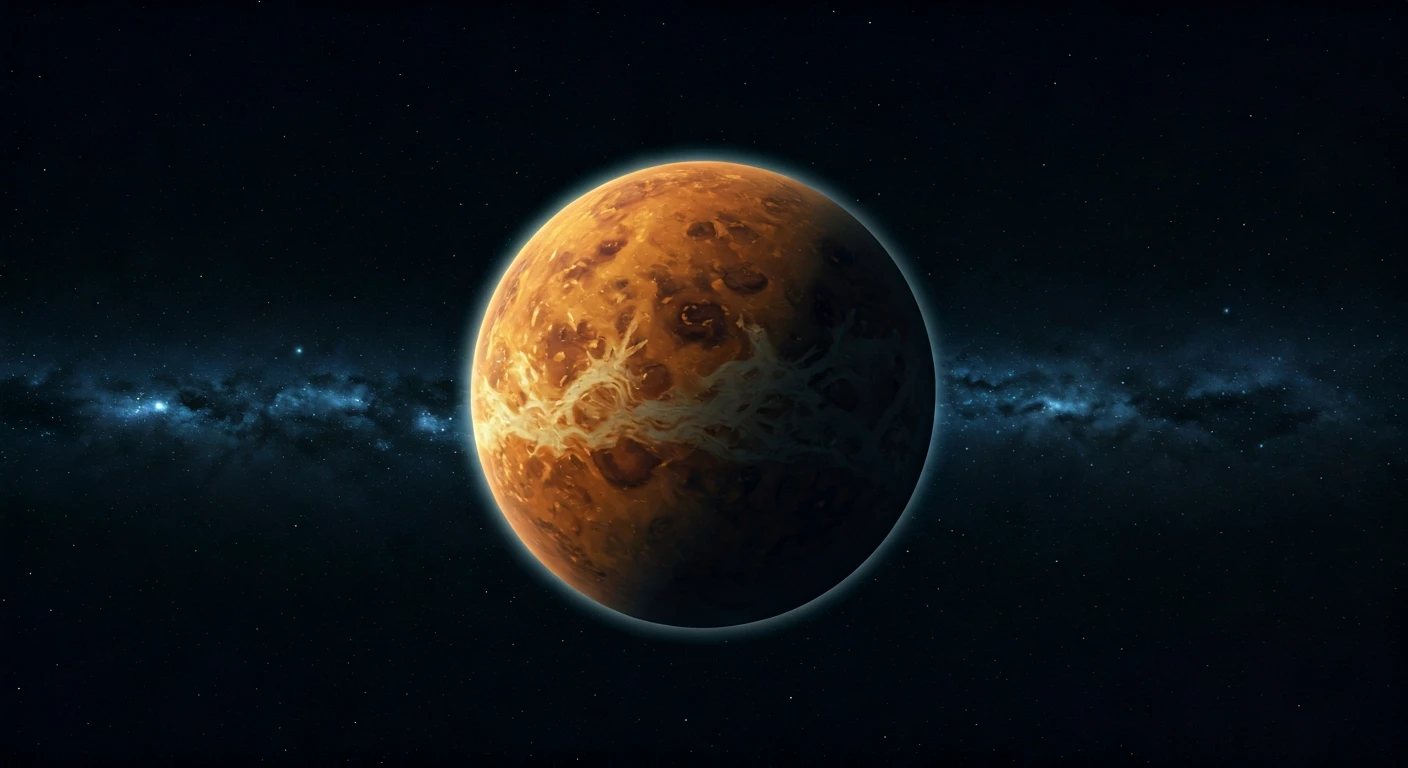
This strange timing is just one aspect of what makes Venus a truly alien and inhospitable planet. Often called Earth's 'twin' due to its similar size, it is a hellscape with surface temperatures hot enough to melt lead, crushing atmospheric pressure 92 times that of Earth, and clouds of sulfuric acid. [16, 21] Its slow rotation and runaway greenhouse effect are deeply connected. Unlike Earth, where a fast spin helps distribute the Sun's heat, Venus's long days and nights contribute to its extreme climate, making it a fascinating but deadly world. [21]