


A New Eye on the Cosmos
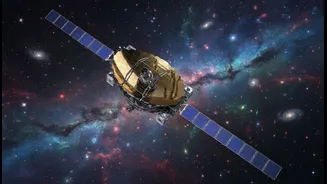
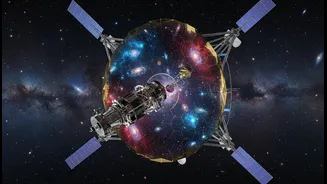
Scheduled to launch around August 30, 2026, the Nancy Grace Roman Space Telescope is NASA's next-generation observatory. Named after the agency's first Chief of Astronomy, this telescope is designed to tackle some of the biggest questions in astrophysics,
including the mysteries of dark energy and the census of planets beyond our solar system. While it has a mirror the same size as the Hubble Space Telescope's, Roman's key advantage is its immense field of view. Its powerful 300-megapixel camera can capture an area of the sky 100 times larger than Hubble or the James Webb Space Telescope (JWST) can see in a single snapshot. This wide-angle vision makes it a survey powerhouse, capable of mapping the sky with unprecedented speed and efficiency.
Bending Light to Find Planets
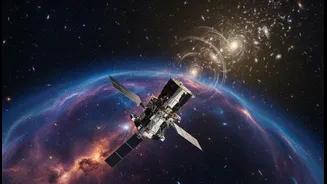
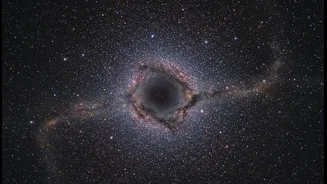
Roman's primary method for planet hunting is a mind-bending phenomenon predicted by Albert Einstein's theory of general relativity called gravitational microlensing. The theory states that massive objects warp the fabric of spacetime. When a star or planet passes almost perfectly in front of a more distant star from our point of view, its gravity acts like a giant magnifying glass. This 'lens' bends and amplifies the light from the background star, causing it to appear temporarily brighter. If the foreground star also has a planet orbiting it, the planet’s own smaller gravity creates a secondary, briefer spike in the brightness. This characteristic pattern signals the presence of a planet, even one that is too far or too dim to be seen directly.
Hunting for Galactic Nomads
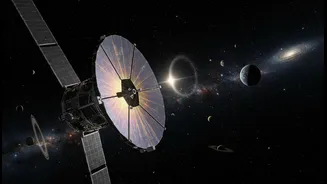
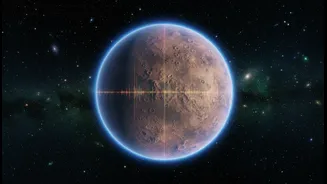
One of the most exciting prospects of Roman's microlensing survey is its ability to find 'rogue planets'. These are worlds that don't orbit a star, instead wandering through the galaxy alone. These planets are nearly impossible to detect with traditional methods because they don't emit their own light and aren't illuminated by a parent star. Microlensing, however, works based on an object's mass, not its light. This makes it the only practical way to find these dark, solitary worlds. By detecting the brief magnifications caused by these wandering planets, Roman could find hundreds, potentially even thousands, of them. Scientists believe there could be trillions of these rogue planets in our galaxy, and Roman’s findings will provide the first robust statistical census of this mysterious population, offering clues about how planetary systems form and sometimes fall apart.
A Different Kind of Planet Hunter
Unlike other famous planet-hunting missions like Kepler, which looked for the dimming of starlight as a planet transits, or Webb, which can study the atmospheres of known planets in great detail, Roman fills a crucial gap. The transit method is best for finding planets orbiting very close to their stars. Microlensing, on the other hand, is most sensitive to planets at wider orbits, similar to Jupiter or Saturn in our own solar system, as well as those with lower masses, like Earth. This makes Roman a complementary tool to other telescopes. It will find planets in a different orbital region, helping astronomers build a more complete picture of planetary system architecture throughout the Milky Way. It is expected to discover thousands of new planets, potentially increasing the number of known exoplanets by an order of magnitude.