


The Tyranny of the Rocket Equation
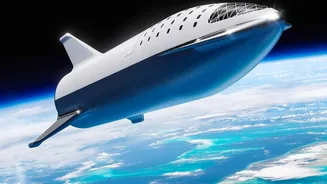
Every spacecraft launched today, from a small satellite to a Mars rover, is bound by the fundamental limitations of chemical rockets. These engines work by burning massive amounts of propellant to create a powerful, but brief, burst of thrust. To go faster
or farther, a rocket needs more fuel. But more fuel adds more weight, which in turn requires even more fuel to lift. This challenging cycle is why traditional spacecraft spend most of their journey coasting, their engines silent after the initial push. It's incredibly effective for getting out of Earth's gravity but highly inefficient for long-haul cosmic journeys where constant acceleration is needed.
A New Engine: Pushing with Photons
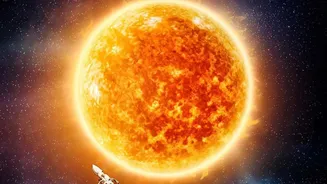
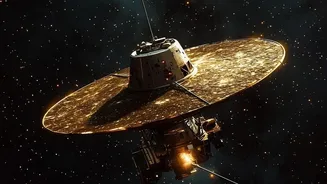
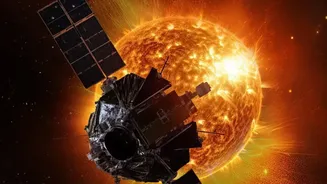
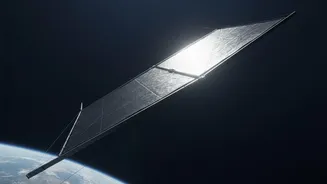
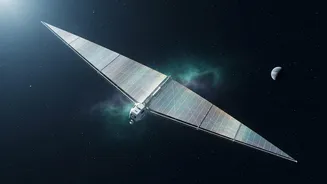
Light-driven propulsion flips the script. Instead of carrying heavy fuel, it uses the momentum from photons—particles of light—to push a spacecraft. This can be done in two main ways. The first is a solar sail, which is a massive, ultra-thin, reflective sheet that catches photons from the Sun, much like a boat’s sail catches the wind. The second, more powerful concept is a beamed-energy system. This involves using a powerful, ground-based laser to push a much smaller sail. The laser provides a far more intense and focused beam of light than the sun, enabling much greater acceleration. In both cases, the spacecraft itself carries little to no propellant, freeing up mass for scientific instruments or other cargo.
The Advantage of Endless Acceleration
The key advantage of light propulsion is its continuous thrust. While the force exerted by photons at any given moment is tiny—a large solar sail might only feel the force equivalent to the weight of a paperclip—this gentle push is constant. In the frictionless vacuum of space, this small but relentless acceleration can build up over weeks and months, eventually allowing a spacecraft to reach speeds far beyond what chemical rockets can achieve. Because they don't depend on finite fuel reserves, light-driven craft could theoretically accelerate for the entire first half of their journey, unlocking possibilities for missions across the solar system and even to other stars.
From Science Fiction to Test Flights
What once sounded like pure science fiction is now being actively tested. Japan's IKAROS probe, launched in 2010, was the first to successfully demonstrate solar sail technology in interplanetary space. More recently, The Planetary Society's LightSail 2, launched in 2019, successfully used a solar sail to raise its orbit around Earth, proving the concept works. NASA is also developing advanced concepts like diffractive sails that use new materials to be more efficient. On the more ambitious end, the privately funded Breakthrough Starshot initiative proposed a plan to use a massive ground-based laser array to propel tiny 'nanocraft' on sails to the Alpha Centauri star system, though the project is currently on hold due to its immense cost and technical challenges.
The Hurdles to Interstellar Travel
Despite its promise, light propulsion faces significant engineering hurdles. Solar sails become less effective the farther they travel from the Sun, as the sunlight weakens. Laser-powered sails require building immensely powerful and precise laser arrays on Earth or in space, a monumental undertaking. Materials for the sails must be incredibly lightweight, durable, and reflective, capable of withstanding years of cosmic radiation and temperature extremes. Perhaps the biggest challenge for an interstellar mission is deceleration; arriving at a destination star system at 20% the speed of light is useless if you can't stop. Concepts like using a detached part of the sail to reflect the laser back for braking have been proposed, but remain highly theoretical.