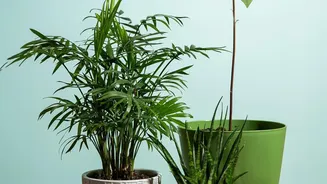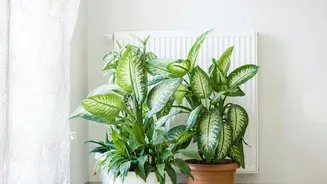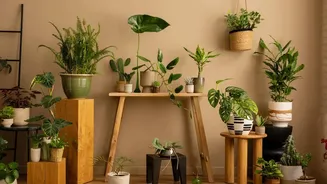






We all love the idea of a home filled with lush greenery that doubles as a natural air purifier. When the air quality outside turns severe, it's tempting to think our indoor jungle is protecting us. But is a fiddle-leaf fig truly a match for smog?
The Green Myth's Origin Story
The
popular belief that houseplants are powerful air purifiers can be traced back to a landmark 1989 NASA study. Facing the challenge of keeping air clean in sealed space stations, researchers placed common houseplants in small, airtight chambers and injected pollutants like benzene and formaldehyde. The results were promising: the plants, along with microbes in their soil, were able to remove a significant portion of these volatile organic compounds (VOCs) from the chamber's air. This single study sparked a decades-long trend, with lists of 'air-purifying' plants becoming a staple in home and wellness media. The idea was simple, affordable, and aesthetically pleasing, a perfect combination for mass appeal.
From a Sealed Lab to Your Living Room
The problem is that your home is not a sealed NASA chamber. Later analysis by researchers, including a comprehensive 2019 review, highlighted the major differences between the lab and real-world conditions. Our homes and offices have much larger volumes of air, which is constantly being exchanged through ventilation, open windows, and tiny cracks in the building. This natural air exchange process removes pollutants far more effectively and quickly than a few potted plants can. The original studies were conducted in tiny, static environments, which greatly exaggerated the plants' impact. When you scale up from a small box to an actual room, the cleaning effect of the plants becomes almost negligible.
Putting the Numbers into Perspective
So, how many plants would it actually take to make a difference? According to modern scientific analysis, the number is staggering. To achieve the same air-cleaning rate as a building's standard ventilation system or simply opening a couple of windows, you would need to place anywhere from 10 to 1,000 plants per square metre of floor space. To put that in perspective, a small 100-square-foot room would require a dense forest of at least 100 plants, and likely many more, to have a meaningful impact. It quickly becomes clear that relying on houseplants for air purification is simply not practical. You would essentially need to live in a greenhouse.
The Real Danger: Smog and PM2.5
Most importantly, the original research focused on gaseous pollutants called VOCs. Smog, the kind that chokes our cities, is primarily composed of something different and more dangerous: fine particulate matter, or PM2.5. These microscopic particles penetrate deep into our lungs and bloodstream, causing significant health problems. Scientific consensus is clear that houseplants do next to nothing to remove PM2.5 from the air. Their biological processes are geared towards absorbing gases, not capturing solid particles. So, during a severe smog event, your snake plant and peace lily are unfortunately not providing a shield against the most harmful components of the polluted air.
What Actually Works Against Indoor Smog
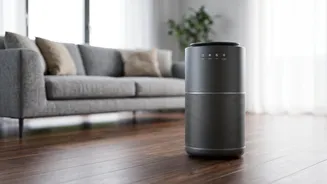
If plants aren't the answer, what is? For true protection, you need to turn to technology and practical measures. The most effective tool is a high-'efficiency particulate air (HEPA) filter. Certified HEPA purifiers are designed to capture at least 99.97% of particles at 0.3 microns, making them highly effective against PM2.5. For best results, choose a purifier with a Clean Air Delivery Rate (CADR) appropriate for your room size and run it continuously with windows and doors closed. Other crucial steps include sealing air leaks around windows and doors, avoiding activities that create more indoor pollution like burning candles or incense, and using exhaust fans sparingly. Creating a dedicated 'clean air room' with a running HEPA purifier can be a lifesaver during heavy smog days.