
What's Hiding in the Dust?
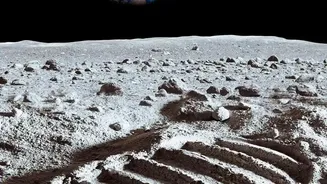
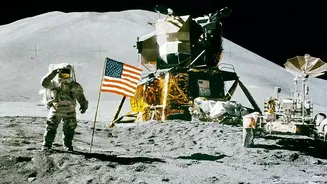
The Moon's surface is covered by a layer of fine, sharp dust and rock fragments called regolith. For decades, scientists have known this material is more than just dirt. By weight, lunar regolith is about 45% oxygen. It is not free-floating gas, but chemically
bound up within minerals like silica, aluminum, and iron oxides. Beyond oxygen, the Moon holds other vital resources. In permanently shadowed craters at the lunar poles, where temperatures are incredibly cold, scientists have confirmed the presence of water ice mixed into the soil. The regolith also contains useful metals like iron, aluminum, silicon, and titanium. More speculatively, the soil is embedded with Helium-3, a rare isotope deposited by solar winds over billions of years, which could one day fuel clean nuclear fusion reactors on Earth.
Baking Rocks for Air and Fuel
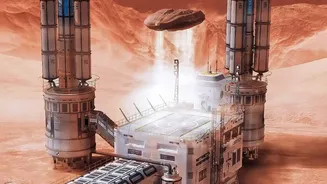
The most critical resource locked in the lunar soil is oxygen. While vital for breathing, its main purpose in space would be to serve as rocket propellant oxidizer. Extracting it is a top priority for agencies like NASA and the European Space Agency (ESA). The leading method is called molten oxide electrolysis. The process involves heating the regolith to extreme temperatures—around 1,700°C—until it melts. An electric current is then passed through the molten rock. This splits the chemical bonds of the metal oxides, causing pure oxygen to bubble up at an electrode where it can be collected. The leftover material is a mixture of molten metal alloys, which could also be used for other purposes. Several research groups and companies are refining this process, designing reactors that can operate efficiently in the vacuum of space to turn lunar dust into a life-sustaining, mission-enabling resource.
Mining for Water in Perpetual Darkness
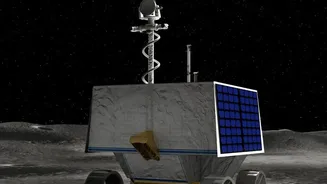
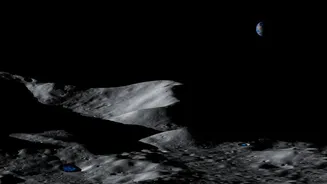
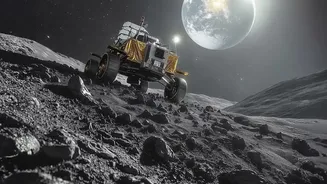
Water is the 'oil of space', not just for drinking but because it can be split into hydrogen and oxygen—the two primary components of rocket fuel. Prospecting missions have confirmed that water ice exists in permanently shadowed regions near the Moon's poles, mixed in with the regolith like frost in frozen ground. Extracting this ice presents a different challenge. The leading concept involves robotic rovers that can operate in extreme cold and darkness. These rovers would excavate the ice-rich soil and heat it in a contained chamber. As the regolith heats up, the water ice turns directly into vapor (a process called sublimation). This water vapor is then captured and condensed back into liquid water or ice for storage. While the exact concentrations and locations of the most promising deposits still require further ground exploration, mining this water is seen as essential for making a long-term lunar presence sustainable.
Building Habitats with 3D-Printed Dust
Launching building materials from Earth is prohibitively expensive, with some estimates putting the cost at over $1 million per kilogram. To build a sustainable lunar base, we will need to use local materials. This is where lunar regolith becomes a construction material. Scientists are developing techniques to 3D print structures using regolith. One method, called sintering, uses a laser or concentrated sunlight to melt the soil layer by layer, fusing it into a solid, ceramic-like material. This could be used to build landing pads, roads, radiation shields, and even habitats. Another approach involves mixing the regolith with a small amount of recycled plastic polymer to create a durable composite material for 3D printing tools and components. Chinese missions are actively testing bricks made from simulated lunar soil to see how they hold up in space.
The Foundation for a Space Economy
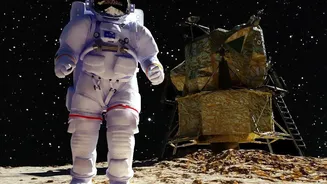
The ability to extract and use lunar resources—a concept known as in-situ resource utilization (ISRU)—is about more than just surviving on the Moon. It is the cornerstone of a future space economy. By producing air, water, and rocket fuel on the Moon, we dramatically reduce the cost and complexity of deep-space missions. The Moon could become a refueling depot for missions heading to Mars and beyond. The metals extracted as a byproduct of oxygen production could be used to manufacture and repair equipment on-site, further reducing reliance on Earth. While challenges like the lack of detailed resource maps and the harsh lunar environment remain, mastering the science of living off the land is the critical next step in transforming humanity from a visitor in space into a true space-faring civilization.