




What Did Webb See?
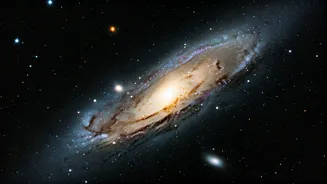
Astronomers pointed the James Webb Space Telescope (JWST) at a neighbour galaxy known as Messier 82, or the Cigar Galaxy, for a total of 65 hours. Located about 12 million light-years away, this galaxy is a popular target for telescopes. But where previous
instruments saw a bright, dusty blur, Webb’s powerful infrared vision pierced through the haze. The result is the most detailed stellar census ever conducted outside our own local galactic group, resolving the galaxy's combined glow into millions of distinct points of light. Each one is a star.
Why the Cigar Galaxy?
The Cigar Galaxy isn't just any neighbor; it's what's known as a 'starburst' galaxy. It's currently forming new stars at a rate about ten times faster than our own Milky Way. This intense period of creation is thought to have been triggered by a past gravitational run-in with a nearby galaxy, M81. This makes M82 a perfect natural laboratory for studying how galaxies evolve during these brief but frantic phases. Most starburst galaxies are too far away for us to see individual stars, but M82's relative proximity makes it the perfect candidate for Webb's powerful eye.
More Than Just a Big Number
Counting 16.5 million stars is impressive, but it's what scientists can do with this information that truly matters. Seeing individual stars, instead of just the collective light of a galaxy, allows astronomers to build a 'fossil record' of M82's history. By studying the types, ages, and distribution of these stars, they can piece together how the starburst started and how it has progressed over time. It's like switching from looking at a satellite image of a forest to being able to walk among the individual trees, identifying each species and seeing how the ecosystem works up close.
The Power of Infrared Vision
The biggest challenge in observing the Cigar Galaxy has always been dust. The same raw materials that fuel its incredible rate of star birth also create thick clouds that obscure visible light. Telescopes like Hubble have studied M82 for decades, but much of its interior remained hidden. Webb was designed specifically to overcome this problem. Its instruments detect infrared light, which can pass through dust clouds more easily. This unique capability, combined with a long observation time, allowed Webb to cut through the galactic smog and reveal the millions of stars shining within.
What Happens Now?
This massive dataset is a treasure trove for astronomers worldwide. The 16.5 million stars identified are believed to be only a fraction of the galaxy's total population, with countless fainter stars still waiting to be found. Scientists will now mine this data to understand the complex interplay of star formation, stellar winds, and the chemical evolution of a galaxy in overdrive. As principal investigator Adam Smercina described it, M82 is a 'beautiful mess' that offers a window into many of the biggest questions in astrophysics. This detailed view will help unravel the mysteries of one of the most dynamic objects in our cosmic neighborhood.