








The Science of Deeper Memory
Why does writing things down make them stick? It’s about more than just documentation. The act of nature journaling forces you to slow down and pay close attention. When you translate an observation—the rough texture of bark, the specific chirp of a bird,
the direction of the wind—into words or a sketch, you engage multiple parts of your brain. The physical act of writing by hand, in particular, strengthens the connection between your short-term and long-term memory, signaling to your brain that this information is important. This process is more active than passively snapping a photo. It requires you to observe, process, and then re-create your experience on the page, building stronger, more durable neural pathways associated with that memory. Studies show this kind of expressive writing and drawing leads to deeper comprehension and a more complete record of what you experience.
Capturing the Unseen Details
A photograph captures a visual moment, but a journey is a full-body experience. A nature journal is your tool for recording the sensory details that give a memory its richness. Think beyond what you see and actively engage your other senses. For sound, you can create a “sound map” by marking your position in the centre of a page and then placing the sounds you hear—near and far, loud and soft—around it. What do you hear? The buzz of an insect, the rustle of leaves, the distant hum of a city? For texture, use descriptive words or even rubbings. Close your eyes and touch a leaf, a rock, or the soil. Is it smooth, gritty, damp, or brittle? For weather, note the temperature, the feel of the sun or rain, and the direction of the wind. Describing these elements helps to transport you back to the moment far more effectively than a simple picture of a sunny sky.
How to Get Started
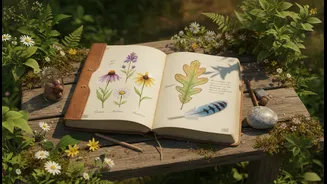
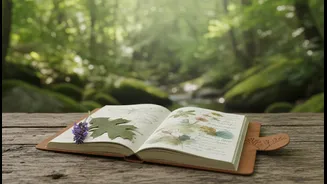
The best part about nature journaling is that there are no rules and you don't need to be a talented artist or writer. Your journal is for you alone. Start with a simple notebook and a pen or pencil. Portable watercolour sets or coloured pencils can add another layer, but they aren't necessary. The goal is observation, not perfection. Try simple prompts to get started. Ask yourself questions like: “What is the loudest sound I can hear?” or “What does the air smell like in this spot?”. Use a mix of words, doodles, and diagrams. You could sketch the shape of a distinctive leaf, write a short sentence about the changing light, or create a list of the colours you see. Combining words, pictures, and even numbers creates a richer and more dynamic record of your experience.
Making It a Travel Ritual
Integrating nature journaling into your travels doesn't have to be a chore. Instead of saving it for the end of the day, keep your journal handy and pull it out for just a few minutes whenever you pause. While waiting for a train, resting on a park bench, or having your morning coffee outdoors, take a moment to record one specific sensory detail. This practice not only builds a repository of memories but also enhances your travel experience in the present. By training yourself to notice the small things—the way light filters through a canopy, the texture of a stone wall, the symphony of evening insects—you cultivate a deeper awareness and connection to the places you visit. It transforms you from a passive tourist into an active, engaged observer, making your adventures more meaningful and your memories more profound.