






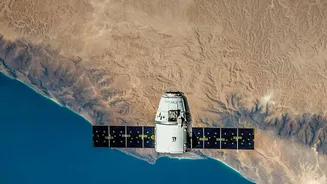
Elon Musk’s vision extends beyond just reaching Mars. He’s talking about building a self-sustaining city, which requires a surprising but critical component: local, high-power computing. This is where the idea of off-planet AI processing comes in.
The Tyranny of Distance and Data
Imagine
trying to have a video call where every response takes between six and 40 minutes to arrive. That’s the reality of communicating between Earth and Mars. Depending on the planets' orbits, the distance can be anywhere from 55 million to 400 million kilometres. This isn't a problem of slow technology; it's a fundamental limit set by the speed of light. For a future Martian colony, this communication lag makes real-time control of systems from Earth impossible. You couldn't remotely operate a rover to avoid a sudden hazard or manage a life-support system during an emergency. Furthermore, there are periods of about two weeks every two years when the Sun is directly between the planets, completely blocking all communication. This inherent delay and potential for blackouts means a Martian settlement cannot rely on Earth for its computational needs. It must have its own brain.
Why Mars Needs its Own Brain
For a city on Mars to be self-sufficient, as Musk envisions, it needs to be able to think for itself. This requires massive local data processing capabilities. Artificial intelligence would be essential for managing the complexities of a Martian habitat. AI systems could autonomously run life support, optimise power generation from solar arrays, manage the production of resources like water and propellant, and operate fleets of robotic workers. These robots, such as the proposed Tesla Optimus, would be tasked with building infrastructure, mining for resources, and performing maintenance—tasks far too dangerous or tedious for the first human colonists. All of this requires constant data analysis and decision-making that simply cannot wait for instructions from Earth. Musk’s recent statements suggest that moving AI compute off-planet isn't just for Mars, but also a solution for Earth's own growing energy demands from data centers. In late 2026, he asserted that space could become the most cost-effective place for AI infrastructure within years, leveraging continuous solar power in orbit.
SpaceX: The Hardware and the Highway
This is where SpaceX's role becomes clear. The company is developing two key technologies that make off-planet computing feasible: Starship and Starlink. The Starship rocket is designed to carry payloads of over 100 metric tons to the Martian surface. This immense capacity is what would make it possible to transport the necessary hardware—servers, cooling systems, and power infrastructure—to build data centers on another planet. A single Starship could potentially carry the components for a small data center or the power systems needed to run it. Starlink, SpaceX's satellite internet constellation, provides the model for the data highway. While it currently connects users on Earth, Musk has stated that a similar network of satellites with optical laser links could be established around Mars. This would create a high-bandwidth local internet for the planet, connecting habitats, rovers, and scientific instruments, and then relaying summarised data back to Earth, overcoming the limited bandwidth that currently slows data transmission from Mars.
The Challenges of Computing in a Harsh Environment
Building a data center on Mars is not as simple as shipping servers. The Martian environment is incredibly hostile. The planet has a very thin atmosphere, offering little protection from harmful cosmic and solar radiation, which can corrupt data and damage sensitive electronics. While some older technologies like vacuum tubes are more radiation_resistant, modern semiconductors are essential for the kind of high_performance computing AI requires. This means any hardware sent to Mars must be specially 'hardened' against radiation. Another major challenge is heat dissipation. Data centers on Earth generate immense heat and require sophisticated cooling systems, often using water. In the near_vacuum of Mars, getting rid of waste heat is a significant engineering problem that will require innovative solutions. Finally, there's the issue of power. A data center is energy_hungry, and a Martian colony would need to deploy vast solar arrays or develop other power sources, like the small_scale nuclear fission reactors NASA is researching, just to keep the lights—and the servers—on.