
Identifying a Cosmic Outsider
Before we can trace an object’s origin, we first have to be certain it’s not from around here. Objects born in our solar system, from giant planets to tiny comets, are all gravitationally bound to our Sun. They follow closed, elliptical orbits, destined
to loop around forever. An interstellar object, however, is just passing through. It arrives with so much speed that the Sun's gravity can't capture it. Instead of a closed ellipse, it follows an open-ended path called a hyperbolic trajectory. Astronomers calculate this trajectory by taking precise measurements of the object's changing position. If the path is hyperbolic, with an eccentricity greater than 1, they know they have a visitor from another star.
Case File 1: The Enigma of ‘Oumuamua
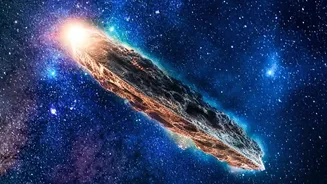
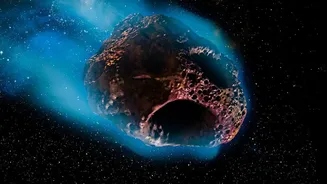
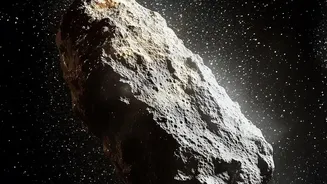
Our first confirmed interstellar visitor, 1I/‘Oumuamua, was a true mystery. Discovered in 2017, it was small, oddly shaped like a pancake or cigar, and showed no visible tail of gas and dust like a typical comet. Yet, it accelerated away from the Sun slightly faster than gravity alone could explain. One of the most compelling theories, proposed by astrophysicists at Arizona State University, is that 'Oumuamua was a nitrogen iceberg—a fragment knocked off a Pluto-like planet in another solar system about half a billion years ago. As it neared our Sun, the frozen nitrogen would have turned to gas, creating a subtle, invisible rocket effect that caused its strange acceleration. This theory connected its strange behavior directly to a plausible origin story.
Case File 2: The Familiar Face of Borisov
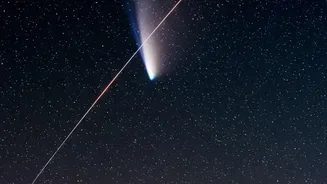
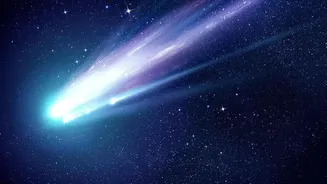
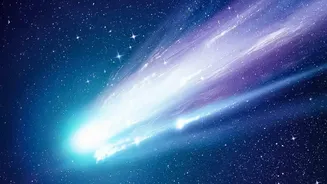
The second visitor, 2I/Borisov, discovered in 2019, was much more familiar. It looked and behaved like a classic comet, complete with a halo of gas and a long tail. But its chemistry was peculiar. It contained a surprisingly high concentration of carbon monoxide, far more than any comet from our own solar system seen at a similar distance from the Sun. This abundance offered a major clue to its origin. Scientists suggested that Borisov may have formed in a very cold region around a red dwarf star, a type of star smaller and cooler than our Sun. Its composition was a direct sample of the chemical building blocks of a completely different planetary system.
The Challenge of Tracing a Path Home
Pinpointing an exact home star for these objects is incredibly difficult. It involves tracing the object's trajectory backwards in time, but this calculation is complicated by the fact that everything in the galaxy is moving. Stars, including our Sun, orbit the galactic center, and gravitational nudges from other stars and gas clouds can alter an object's path over millions of years. For a hypothetical third visitor like 3I/ATLAS, even with precise measurements of its path through our system, tracing it back to a single point of origin is a monumental challenge. However, astronomers can determine the general direction it came from and its velocity relative to the galaxy, which helps them identify the type of stellar population it belongs to, such as the galaxy's thin or thick disk.
Why Origin Unlocks Everything
Knowing where an object came from provides essential context for everything else we observe. The composition of 2I/Borisov, for instance, makes more sense if it originated in the frigid outer reaches of a planetary system around a cool red dwarf. An object's origin story tells us about the chemistry and dynamics of its home system. Was it violently ejected by a giant planet? Is it a fragment from a catastrophic collision? Is it a pristine relic from the dawn of another solar system? Each interstellar object is a priceless messenger carrying a sample of its home world. Its origin is the return address on the package, giving us the context needed to read the message inside and learn about the incredible diversity of planetary systems across the galaxy.