

Why Your Deep Core Matters
When we talk about the 'core', it's not just the six-pack muscle (rectus abdominis). It’s a complex system of muscles that acts like a supportive cylinder for your entire torso. This includes the deep transverse abdominis, obliques, back muscles, diaphragm,
and pelvic floor. A strong, stable core protects your lower back, improves posture, enhances balance, and allows for more efficient movement in daily life and athletic activities. Unlike exercises that focus only on crunching motions, yoga builds functional strength by asking your core to stabilise the body in various positions, teaching it to resist unwanted movement and maintain control. Holding poses, in particular, builds muscular endurance and deepens your awareness of this crucial muscle group.
Marjaryasana-Bitilasana (Cat-Cow Pose)
While often performed as a flowing movement, slowing down and mindfully holding each part of Cat-Cow can awaken the core muscles. It's a foundational pose that gently stretches and strengthens the spine and abdomen.How to do it: Start on your hands and knees in a tabletop position, with wrists under shoulders and knees under hips. As you inhale (Cow Pose), drop your belly, lift your chest and tailbone, and look forward, creating a gentle arch in your spine. As you exhale (Cat Pose), press the floor away, round your spine toward the ceiling, and tuck your chin to your chest, pulling your navel in firmly. To enhance core engagement, hold each position for three to five breaths, focusing on the muscular contraction in your abdomen during the 'Cat' phase.
Setu Bandhasana (Bridge Pose)
Bridge Pose is a gentle backbend that is excellent for strengthening the glutes, hamstrings, and the entire posterior chain, which are all integral parts of a functional core. It also opens the chest and hip flexors.How to do it: Lie on your back with your knees bent, feet flat on the floor hip-width apart, and close enough that you can touch your heels with your fingertips. Rest your arms alongside your body, palms down. On an inhale, press through your feet and lift your hips off the floor. To activate the core, imagine pulling your navel towards your spine and keep your glutes engaged. Hold this 'bridge' shape for five to eight steady breaths. Ensure your knees stay aligned over your ankles and don't splay outwards. Slowly lower down one vertebra at a time on an exhale.
Dandasana (Staff Pose)
Though it looks simple, Staff Pose is a powerful posture for building spinal awareness and core strength. It's the foundation for many other seated poses and teaches you how to maintain an upright posture from your core.How to do it: Sit on the floor with your legs extended straight in front of you. Place your hands on the floor beside your hips with fingers pointing forward. Press down through your palms to help lift and lengthen your spine. Actively flex your feet, drawing your toes back towards you. Engage your thigh muscles and gently pull your lower belly in and up to support your lower back. Your goal is to create a 'staff' with your spine, sitting tall without slouching. Hold for five to ten breaths, focusing on maintaining the lift in your torso.
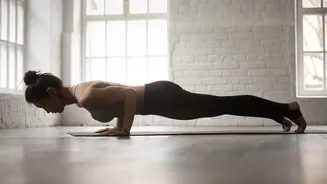
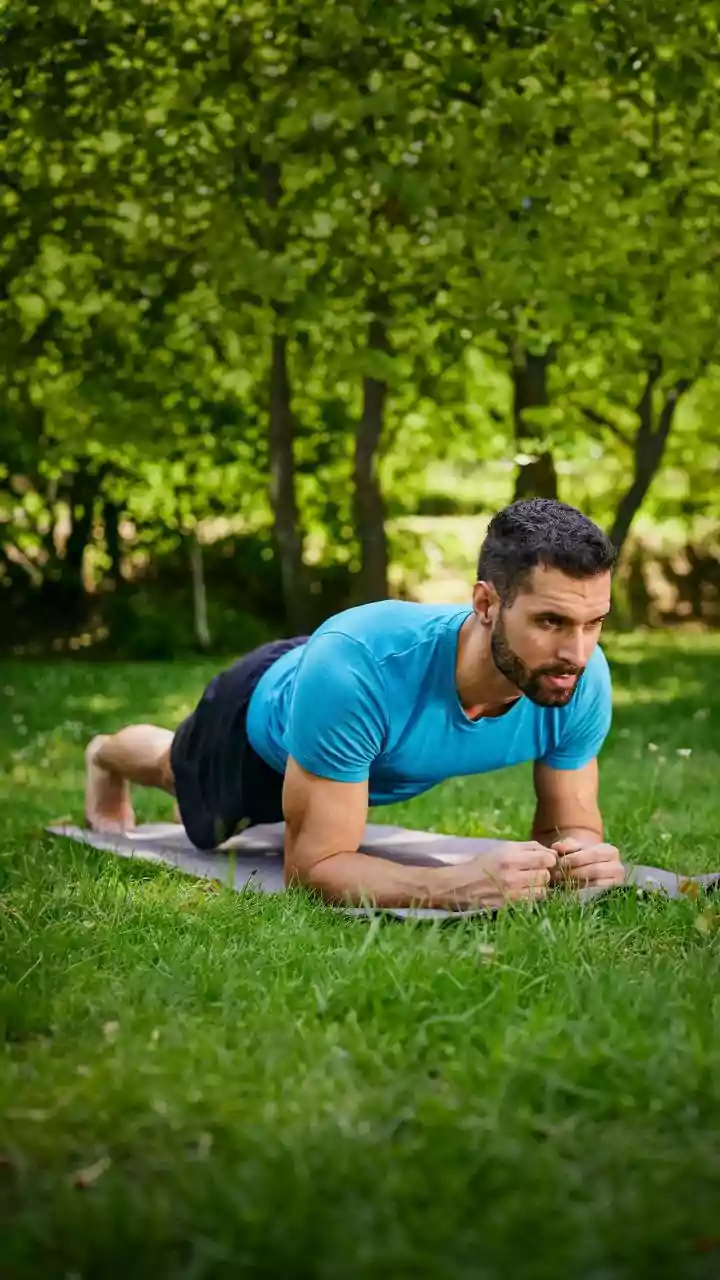
Modified Phalakasana (Forearm or Knee Plank)
Plank is a quintessential core-strengthening pose, but the full version can be intense. A modified plank offers the same benefits by forcing your abdominal muscles to work to prevent your hips from sagging, but with less strain.How to do it: You can modify Plank in two main ways. For a forearm plank, rest on your forearms instead of your hands, keeping your elbows directly under your shoulders. For a knee-down plank, simply lower your knees to the floor from a standard plank position, ensuring your back is a straight line from your shoulders to your knees. In either variation, actively draw your navel towards your spine to engage your core. Avoid letting your lower back arch or your hips pike up. Start by holding for 20-30 seconds, gradually increasing the time as you build strength.