





A Cosmic First Responder
Launched in 2004, the Swift Observatory is a space telescope with a unique skill: speed. It was designed to hunt for gamma-ray bursts (GRBs), the most powerful explosions in the universe, which can flare up and fade in minutes. When its Burst Alert Telescope
detects a flash, the entire satellite can autonomously pivot in under a minute to aim its X-ray and UV/Optical telescopes at the source for a closer look. This rapid reaction has made it an indispensable tool for astronomers, providing crucial data on everything from collapsing stars to merging neutron stars. Despite being designed for a two-year mission, Swift has delivered invaluable science for more than twenty years, becoming a general-purpose observatory for all sorts of cosmic transients.
A Race Against Gravity
The primary problem facing Swift isn't a broken part in the traditional sense, but the relentless pull of Earth's atmosphere. All satellites in low Earth orbit experience atmospheric drag, which gradually lowers their altitude. Swift, which has no onboard propulsion to counteract this, has been slowly sinking from its original 600-kilometer orbit. This orbital decay was recently accelerated by a period of high solar activity, increasing the drag and putting the observatory at risk of re-entering the atmosphere and burning up as early as 2026. While the observatory has also faced issues with its gyroscopes—the spinning wheels that help it point—the immediate, existential threat is its falling orbit. Without a boost, a $500 million observatory that is still scientifically valuable would be lost forever.
Enter the Robotic Mechanic
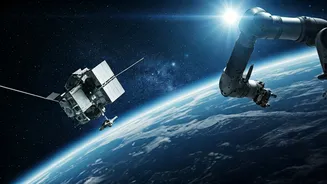
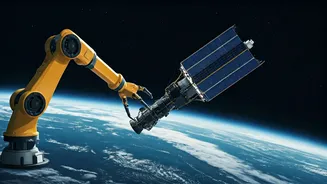
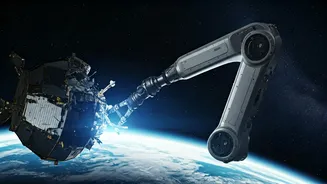
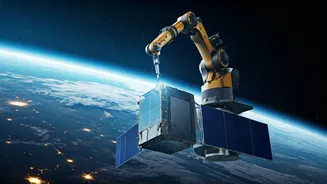
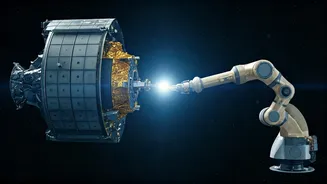
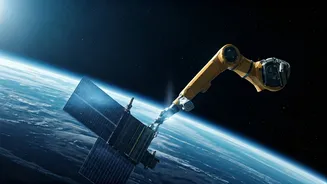
Instead of letting the valuable observatory be destroyed, NASA opted for a novel solution: hire a robotic mechanic. In September 2025, the agency awarded a $30 million contract to Katalyst Space, an Arizona-based startup, to design and fly a rescue mission. This first-of-its-kind commercial mission will use a robotic servicing spacecraft called LINK to rendezvous with Swift, grab it, and tow it to a higher, more stable orbit. The mission represents a daring new approach, as Swift was never designed to be grappled, refueled, or serviced in any way. It has no docking port or convenient handles. The LINK spacecraft will have to carefully assess the observatory and use its three robotic arms to secure a firm grip before firing its own gentle thrusters.
A High-Stakes Launch
Getting the LINK spacecraft into orbit is a challenge in itself. The mission uses Northrop Grumman's Pegasus XL rocket, a unique air-launch system where the rocket is dropped from a carrier aircraft, the L-1011 Stargazer, at 40,000 feet before igniting. After multiple weather delays, a launch attempt on July 2, 2026, was scrubbed due to an issue with the launch vehicle, delaying the start of this critical rescue. Once it successfully launches from Kwajalein Atoll in the Pacific, LINK will spend several weeks approaching Swift, inspecting it, and preparing for the capture. The boost phase itself will take four to six weeks, during which LINK’s ion thrusters will slowly raise Swift's orbit back to a safe altitude, extending its life for years to come.
Pioneering a Sustainable Future in Space
The Swift boost mission is more than just a single repair job; it’s a landmark demonstration of what the future of space operations could look like. Successfully servicing a satellite that wasn't designed for it proves the viability of on-orbit servicing, a capability that could extend the lives of countless other satellites, both government and commercial. This could dramatically change the economics of space, making it more sustainable. Instead of launching expensive replacements, operators could refuel, repair, or upgrade existing assets. This technology is a critical step toward actively managing space, from extending missions to eventually cleaning up orbital debris, ensuring that space remains a viable domain for exploration and commerce for decades to come.