





What Are Perovskite Solar Cells?
First, let's clear up a common misconception: perovskite isn't a single element like silicon. It’s a specific type of crystal structure. Think of it like a set of building blocks that can be made from various cheap, abundant materials. This special atomic
arrangement is exceptionally good at absorbing sunlight and converting it into electricity. This structural flexibility allows scientists to 'tune' perovskite materials to capture different parts of the light spectrum, a key advantage over traditional silicon which has a more fixed absorption range. The cells themselves are made by creating thin films of this perovskite material, which can be done through relatively simple, low-temperature processes—a stark contrast to the energy-intensive methods required to produce high-purity silicon wafers.
The Promise of High Efficiency
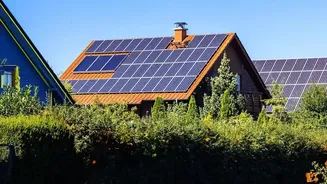
The main buzz around perovskites is their incredible potential for efficiency. In laboratory settings, single-junction perovskite cells have achieved efficiencies that rival the best silicon cells, which have had decades of development. Even more exciting is the concept of 'tandem' solar cells. By placing a thin, semi-transparent perovskite layer on top of a traditional silicon cell, the panel can harvest a much broader spectrum of sunlight. The perovskite layer captures high-energy blue and green light, while the silicon layer below absorbs the lower-energy red and infrared light. This combination has shattered records, with lab prototypes reaching efficiencies of over 34%, well beyond the theoretical maximum for silicon cells alone. For a homeowner, this translates to generating significantly more power from the same amount of roof space.
A Breakthrough in Manufacturing Costs
Beyond efficiency, the second major promise of perovskites is lower cost. Manufacturing conventional silicon panels is a complex, high-temperature process requiring a large amount of energy. Perovskite materials, on the other hand, can be synthesized in a lab and applied as a type of 'solar ink.' This means they could potentially be printed onto surfaces, including flexible substrates, using simple, scalable roll-to-roll manufacturing techniques similar to printing a newspaper. This drastically reduces the energy, time, and capital investment needed for production. While current, early-stage manufacturing costs are still being optimized, some analyses suggest that at scale, perovskite panels could eventually be two to four times cheaper than their silicon counterparts.
The Challenge: Making Them Last
For all their promise, perovskites have faced one major hurdle: durability. Early versions of the technology degraded quickly when exposed to moisture, heat, and even continuous sunlight—precisely the conditions they need to endure on a rooftop for decades. A solar panel that only lasts for a few years is not a viable investment for a homeowner compared to silicon panels, which typically come with a 25-year warranty. This stability issue has been the primary obstacle preventing widespread commercialization, as researchers have worked tirelessly to develop new chemical formulas and protective layers that can withstand the elements without sacrificing performance.
Recent Innovations Paving the Way
The good news is that recent breakthroughs are rapidly solving the durability puzzle. Scientists have developed new chemical additives and encapsulation techniques that make the perovskite crystal structure more robust. Recent studies in 2025 and 2026 have demonstrated new cells that retain over 90% of their initial efficiency after thousands of hours of rigorous testing under high heat and humidity. Some companies have even passed the same industry-standard durability tests that silicon modules are subjected to. In India, significant progress is being made. In July 2026, Indian manufacturer Rayzon Solar announced a major partnership with US-based Caelux to produce 5 GW of perovskite-silicon tandem modules in Gujarat, with commercial volumes expected by 2028. This move aligns with the 'Make in India' initiative and signals a strong future for domestic production of this next-generation technology.