








A First-of-its-Kind Profile
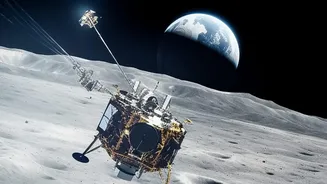
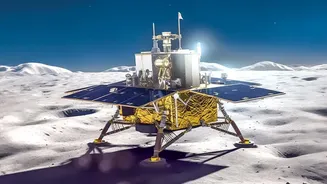
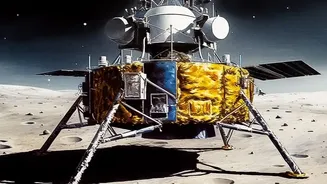
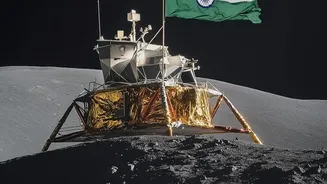
One of the key instruments aboard the Vikram lander, which touched down near the lunar south pole, is the Chandra’s Surface Thermophysical Experiment, or ChaSTE. This instrument was designed to do something no mission has done before in this region: take
the Moon’s temperature not just on the surface, but also just beneath it. The ChaSTE probe, equipped with 10 temperature sensors, penetrated about 10 centimetres into the lunar regolith—the loose layer of dust, soil, and broken rock. This allowed ISRO scientists, for the first time, to create a detailed thermal profile of the topsoil at the lunar south pole.
A Tale of Three Layers
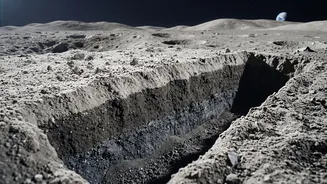
What ChaSTE found was unexpected. Instead of a uniform material, analysis revealed the top 10 centimetres of lunar soil are comprised of three distinct layers, each with its own physical and thermal characteristics. The uppermost layer, down to about 3 cm, is highly porous and fluffy, with a low density. Below that, from 3 to 6 cm, is a middle layer with higher thermal conductivity. Finally, the bottom layer, from 6 to 10 cm, is denser still, with intermediate conductivity. This layered structure, previously unobserved, suggests the soil was deposited by different events over time, possibly from impacts of nearby craters. The initial data already showed a staggering temperature difference, with the surface baking at around 50-60 degrees Celsius while the temperature just 8 cm below plunged to a frigid -10 degrees Celsius.
Why the Moon's Soil is a Super-Insulator
The dramatic temperature drop just a few centimetres beneath the surface demonstrates that the Moon's topsoil is an incredibly effective thermal insulator. In the vacuum of space, heat doesn't transfer through air convection like it does on Earth. Instead, it moves through direct contact between soil grains and by radiation across the tiny gaps, or pores, between them. The analysis from ChaSTE shows the topmost layer is extremely porous—about 80%—and acts like a thermal blanket. It prevents the Sun's intense heat from penetrating deep into the ground, and conversely, it stops the cold from escaping from below. This finding confirms and refines previous theories about the insulating properties of the lunar regolith.
Implications for Future Lunar Habitats
This discovery is not just an academic curiosity; it has profound implications for the future of lunar exploration and human settlement. The extreme temperature swings on the Moon's surface are a major challenge for building sustainable habitats. However, if the lunar soil is such a powerful insulator, future astronauts could potentially use it as a construction material. By building structures a few feet underground or covering habitats with a thick layer of regolith, they could be naturally shielded from the extreme heat of the lunar day and the deep cold of the lunar night. This could dramatically reduce the energy needed for heating and cooling, making long-term lunar bases more feasible. The data also helps engineers identify suitable depths for placing sensitive equipment.
A Key to Finding Water Ice
The thermal properties of the soil are also critical in the search for water ice, a resource considered essential for future missions. The ChaSTE data helps scientists understand how temperature varies with local terrain. It suggests that even small, pole-facing slopes just metres away from sunlit areas could be significantly colder, creating environments where water ice could remain stable just below the surface. This broadens the potential areas where future missions could prospect for water, moving beyond just the permanently shadowed craters at the poles. Understanding how heat propagates through the soil is key to predicting where these valuable deposits might be hiding.