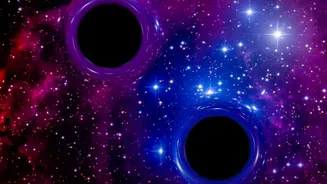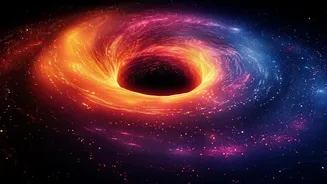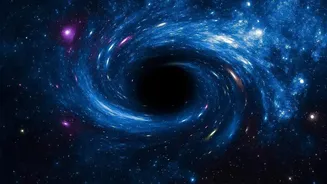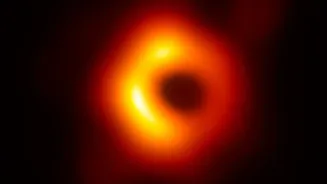




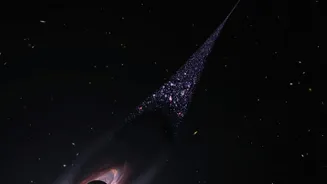
When we picture a black hole, we imagine a cosmic monster swallowing stars. But what if the universe is also filled with ancient, tiny black holes, some no bigger than an atom? This intriguing possibility remains a key puzzle for astronomers.
The Black Hole Family We Know
To understand
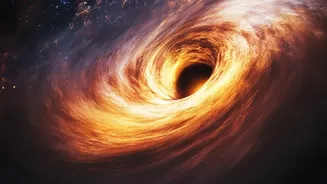
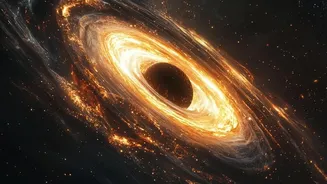
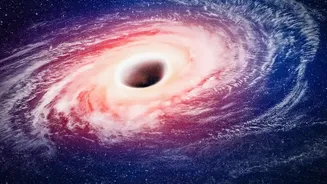
the possibility of smaller black holes, it first helps to know the ones astronomers have already found. Scientists generally classify the black holes they have observed into two main groups based on size. The first are stellar-mass black holes, which typically have a mass between three and dozens of times that of our Sun. These form when a truly massive star, at least 20 times the mass of our sun, runs out of fuel and its core collapses under its own immense gravity, triggering a supernova explosion. The second group contains the supermassive black holes. These are the titans of the universe, lurking at the centres of most large galaxies, including our own Milky Way. They are incomprehensibly vast, with masses ranging from hundreds of thousands to billions of times that of our sun. How they form is still a major area of research.
A Cosmic Size Gap
Between the stellar-mass and supermassive categories, there is a mysterious gap. Astronomers have long searched for 'intermediate-mass' black holes, which would be a crucial missing link, but solid evidence has been hard to come by. But there is another, more radical type of black hole that scientists theorise could exist: primordial black holes (PBHs). These are not formed from dying stars but are thought to be relics from the very birth of the universe. Unlike their star-born relatives, which have a minimum size, primordial black holes could be much, much smaller—some theorists suggest they could have the mass of an asteroid, or even less, packed into a space smaller than an atom.
Born in the Universe's First Second
The theory, first proposed by Stephen Hawking in the 1970s, suggests that in the first fraction of a second after the Big Bang, the universe was not perfectly uniform. It was a chaotic, incredibly dense soup of energy and matter. In this environment, tiny regions that were exceptionally dense could have collapsed under their own gravity, forming black holes long before the first stars ever ignited. This formation pathway means they are not bound by the same mass rules as stellar black holes. This opens up the possibility of a whole population of ancient, smaller black holes scattered throughout the cosmos, a prospect that has fascinated and frustrated physicists for decades.
The Hunt for Cosmic Ghosts
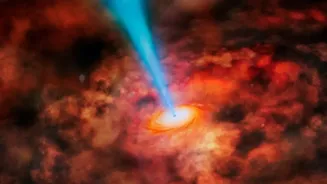
If these small black holes exist, why haven’t we found any? The simple answer is that they are incredibly difficult to detect. A black hole with the mass of an asteroid would be smaller than an atomic nucleus, making it virtually invisible. They don't pull in vast clouds of gas to form the bright accretion disks that help us spot their larger cousins. However, scientists have clever, indirect ways to search for them. One method is through gravitational lensing, where a PBH passing in front of a distant star would briefly magnify its light. Another involves searching for the faint glow of Hawking radiation, a theoretical process where black holes slowly evaporate over eons, releasing a faint stream of particles. So far, these searches have come up empty, placing limits on how many of these black holes could be out there.
A Clue to a Deeper Mystery?
The search for primordial black holes is not just about cataloguing cosmic objects; it is tied to one of the biggest mysteries in all of science: dark matter. This invisible substance makes up about 85% of all matter in the universe, acting as the gravitational 'glue' that holds galaxies together, but we don't know what it is. For a time, PBHs were a leading candidate. While many studies have since constrained this possibility, the idea that some or all of dark matter could be composed of these ancient black holes has not been entirely ruled out. Recent detections of unusual gravitational waves by observatories like LIGO have sparked renewed interest, with some signals potentially pointing to mergers of black holes in a mass range that is hard to explain with conventional star collapse, hinting at a primordial origin. While the evidence is far from conclusive, the possibility that these tiny, ancient objects hold the key to understanding dark matter keeps the hunt alive and well.