
A Decades-Old Solar Mystery
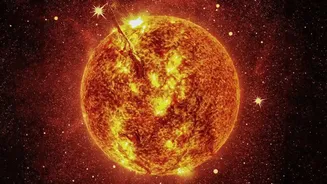
For nearly a century, scientists have been puzzled by the extreme heat of the solar corona. Logically, temperatures should decrease as you move away from a heat source, but the sun defies this logic. Its visible surface, the photosphere, registers around
6,000 degrees Celsius, while the tenuous atmosphere above it, the corona, sizzles at a few million degrees. This conundrum, known as the coronal heating problem, has been a major unanswered question in astrophysics since it was first identified in the late 1930s. The energy to heat the corona must come from the sun's turbulent surface, but the exact mechanism for transporting and depositing that energy into the atmosphere has remained elusive. Theories have ranged from countless tiny explosions called 'nanoflares' to the dissipation of energy from powerful magnetic waves.
A Breakthrough Observation
Recent observations have brought a specific type of plasma activity into sharp focus. Using the world's most powerful solar observatory, the Daniel K. Inouye Solar Telescope in Hawaii, astronomers have captured the most detailed images of the sun's surface ever taken. These images revealed tiny, swirling vortices, some only 20 kilometers wide, at the edges of the sun's magnetic regions. These whirlpool-like patterns are the tell-tale sign of a phenomenon called the Kelvin-Helmholtz instability. While this instability is common in nature, seen in clouds and ocean waves on Earth, this was the first time it had been directly confirmed on the sun's visible surface.
What Is Kelvin-Helmholtz Instability?
This instability occurs when two fluids or plasmas moving at different speeds slide past each other. This difference in velocity creates a shearing force at the boundary, which can disrupt the flow and curl it into vortices. On the sun, this happens at the edges of bubbling patterns called granules, where superheated plasma is in constant motion, churned by powerful convection currents and magnetic fields. The Inouye Solar Telescope was able to resolve these fine-scale interactions, showing how the plasma flows were creating these tiny, constant swirls. Think of it like wind blowing over water, creating ripples that can grow into waves; on the sun, it's plasma flowing past other plasma, creating vortices.
The Missing Piece of the Puzzle?
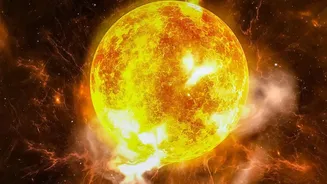
Scientists believe these newly seen swirls could be the missing link in the coronal heating process. The constant swirling motion may act like a persistent engine, twisting and braiding the magnetic field lines that extend from the surface up into the corona. This twisting stores vast amounts of energy in the magnetic field. Eventually, this energy needs to be released. The theory is that the energy from these widespread, small-scale instabilities cascades upwards, dissipating as heat in the much less dense corona. While one swirl is tiny, the fact that they appear to be happening constantly all over the sun's surface means their collective energy contribution could be massive—potentially enough to solve the heating mystery.
What This Means for Solar Science
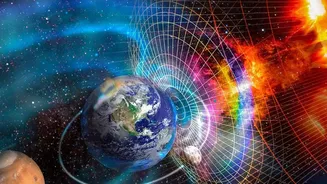
This discovery does more than just offer a compelling solution to the coronal heating problem. Understanding the transfer of energy from the sun's surface is crucial for predicting space weather. The same mechanisms that heat the corona also power solar flares and coronal mass ejections—massive bursts of energy and particles that can travel through the solar system and disrupt satellites, communication networks, and power grids on Earth. By identifying the fundamental process that energizes these events at their source, scientists can build more accurate models of solar activity. This will improve our ability to forecast potentially hazardous space weather, giving us more time to prepare for its effects.