


A Sweet Discovery, Billions of Miles Away
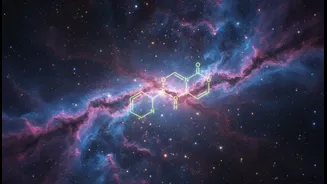
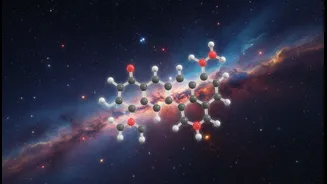
When scientists talk about finding “sugar” in space, they don’t mean the granular white stuff you put in your tea. They are referring to simple organic molecules that are the basic building blocks of carbohydrates. Recently, astronomers detected a four-carbon
sugar called erythrulose in a giant molecular cloud near the center of our galaxy, about 26,700 light-years away. This isn't the first time such molecules have been found. The simpler two-carbon sugar, glycolaldehyde, was detected in 2000. Sugars like ribose and glucose have also been discovered within meteorites that have crashed on Earth and in pristine samples returned from asteroids. These discoveries, made by analyzing the light from distant stars or by directly studying extraterrestrial rocks, confirm that the fundamental ingredients for life’s chemistry are not unique to our planet.
Why This Is a Big Deal
Sugars are absolutely essential for life as we know it. They perform several critical jobs in biology. Most famously, five-carbon sugars form the structural backbone of DNA and RNA, the molecules that carry our genetic code. They also act as a vital energy source for metabolic processes. The fact that these molecules can form in the cold, harsh environment of interstellar space or on asteroids is a huge revelation. It suggests that the raw materials for life weren't necessarily cooked up on early Earth. Instead, they might have been delivered here during the planet's formation, possibly via comets and meteorites during a period known as the Late Heavy Bombardment. This supports the hypothesis that the chemical precursors for life are common throughout the universe, potentially giving life a head start on any suitable planet.
Prebiotic Chemistry, Not Alien Biology
This is the crucial distinction to make. Finding a brick doesn't mean you've found a house, and finding a sugar molecule doesn't mean you've found an alien. The formation of these organic compounds in space is a process known as prebiotic chemistry—the chemical steps that occurred before life emerged. These molecules, including sugars, amino acids, and nucleobases, can be created through non-biological processes. For instance, scientists believe erythrulose forms on the icy surfaces of dust grains from the combination of simpler molecules. This is a fascinating chemical process, but it is not a biological one. Life is defined by its ability to metabolize, grow, and replicate—complex processes that go far beyond the mere presence of its constituent parts. So, while these discoveries are incredibly exciting, they are evidence of cosmic ingredients, not a finished biological recipe.
What It Means for the Search for Life
Discoveries like this refine our search for life beyond Earth. They provide strong evidence that the building blocks of biology are widespread. This makes it more plausible that life could arise elsewhere if the conditions are right. Scientists are no longer just looking for planets in the habitable zone; they are now building a library of the chemical signatures that might indicate a world with the potential for life. The recent detection of numerous organic molecules on Mars by the Curiosity rover is another part of this puzzle. While not proof of Martian life, it confirms that complex chemistry occurred and its products were preserved for billions of years. Future missions, like those using the James Webb Space Telescope, can now hunt for these specific molecules in the atmospheres of distant exoplanets, helping to identify worlds that are most promising for further study.