





The Final Challenge: From Orbit to Ocean
After a successful mission in orbit, the Gaganyaan crew module will face its most perilous trial: atmospheric re-entry. Hurtling towards Earth at more than 28,000 kilometres per hour, the capsule relies on its blunt-body shape and an ablative heat shield
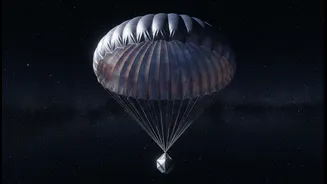
to dissipate the extreme heat. But even after surviving this fiery phase, the module is still moving too fast for a safe landing. Its velocity must be slashed dramatically in the final few kilometres of descent. This is where one of the most critical, non-negotiable safety systems takes over: a multi-stage, automated parachute system designed to transform a plummeting projectile into a gently descending capsule, ready for recovery.
A Ten-Parachute Symphony
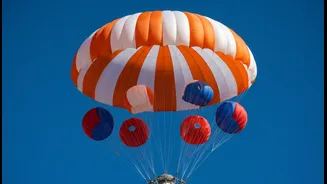
This is not a case of pulling a single cord. The Gaganyaan’s deceleration is a meticulously choreographed sequence involving a total of ten parachutes of four different types. The entire automated process begins when two Apex Cover Separation parachutes deploy to jettison the protective cover that shields the main parachute compartment. Immediately after, two Drogue Parachutes are deployed. These smaller, robust chutes are essential for stabilising the tumbling capsule at high altitude and providing the first major stage of deceleration, preventing the module from entering an uncontrolled spin. Their job is to slow the capsule enough for the next, most crucial phase of the landing. The precision of this sequence is paramount, as each step sets up the success of the next.
Automation: The Unseen Pilot
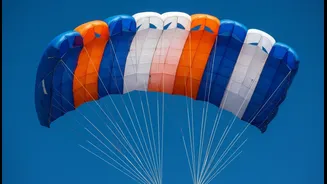
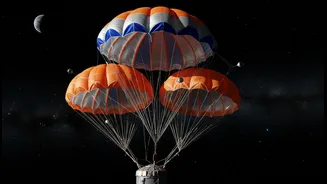
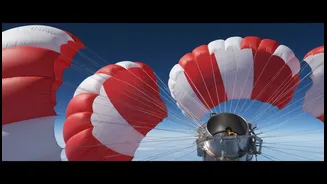
At the speeds and G-forces experienced during re-entry, human intervention is impossible. The entire parachute deployment is therefore automated, governed by an array of sensors measuring altitude, velocity, and atmospheric pressure. These systems trigger pyro-based mortars that eject the parachutes at the exact moment they are needed. Once the drogue chutes have stabilised the module, three Pilot Parachutes are released. Their sole purpose is to pull the three massive Main Parachutes from their compartments. These main canopies are the workhorses of the system, designed to slow the capsule from over 216 metres per second to a splashdown speed of less than 11 metres per second. This automated 'brain' ensures the sequence unfolds perfectly every time, a vital element for crew safety.
Redundancy and Rigorous Testing
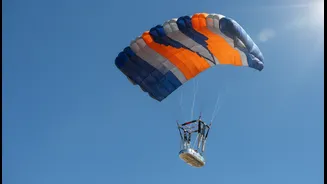
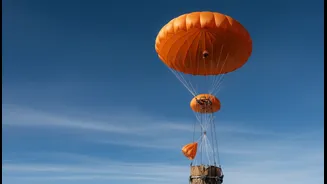
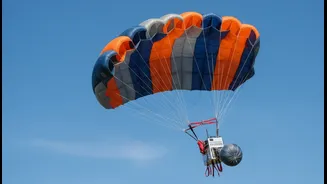
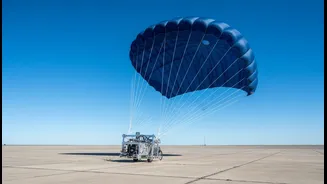
In spaceflight, there is no room for error, which is why the system is built with redundancy. While there are three main parachutes, only two are required for a safe landing; the third provides an essential backup in case one fails to deploy. To ensure this system is flawless, the Indian Space Research Organisation (ISRO), in collaboration with the Defence Research and Development Organisation (DRDO), has conducted a series of grueling tests. Recently, the fifth Integrated Main Parachute Airdrop Test (IMAT-05) was successfully completed in Madhya Pradesh. In these tests, a dummy mass equivalent to the crew module is dropped from an Indian Air Force IL-76 aircraft from an altitude of 2.5 kilometres to simulate landing conditions and validate the parachute's performance under maximum stress. These repeated successes provide the confidence needed for the upcoming uncrewed G1 mission.
Ensuring a Gentle and Stable Splashdown
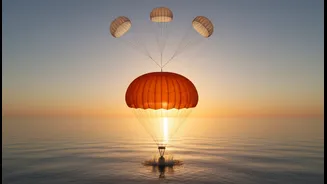
The final goal is not just to slow down, but to ensure a stable and predictable landing in the Indian Ocean. The large main parachutes ensure the module is properly oriented for splashdown. Upon hitting the water, the parachutes are jettisoned to prevent entanglement, and specially designed flotation bags inflate to keep the module upright. This stability is crucial for the recovery teams from the Indian Navy, who need to safely approach the module and retrieve the astronauts. From bright sea-marker dyes to strobe lights for night recovery, every detail is planned to make the final step of the mission as safe as the first. This parachute system is the final, vital link in the chain ensuring India's vyomanauts return home safely.