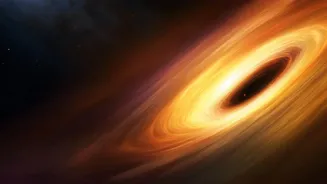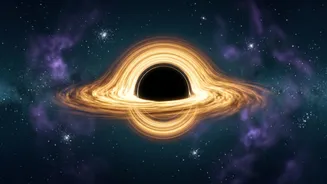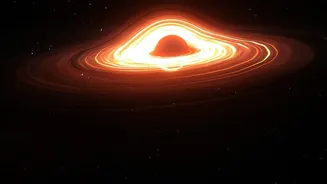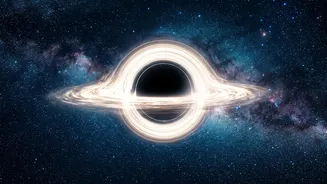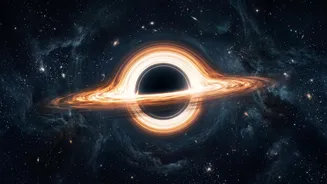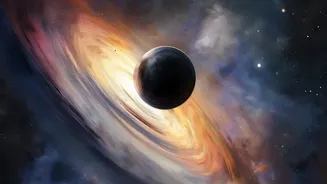

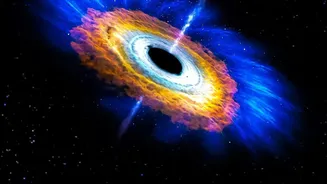
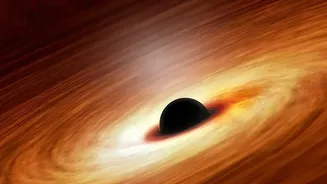
Astronomers believe our galaxy hosts over 10 million black holes, yet we've only found about 70. Now, a groundbreaking project is inviting you to help find the rest, turning your curiosity into a real contribution to science.
The Challenge of Finding the Invisible
Black holes are the universe's
ultimate mystery boxes. Their gravitational pull is so immense that nothing, not even light, can escape, making them functionally invisible to most telescopes. Scientists typically find them indirectly, for example, when a black hole is actively 'feeding' on a nearby star. The material being pulled in heats up and emits powerful X-rays that our instruments can detect. But what about the millions of 'quiet' black holes that are not feeding? These dormant giants drift through the galaxy unseen, and astronomers estimate that the vast majority of black holes in the Milky Way fall into this category. Finding them requires a different, more subtle approach, and a lot more eyes.
Using Gravity as a Magnifying Glass
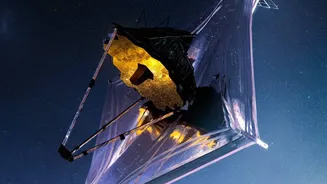
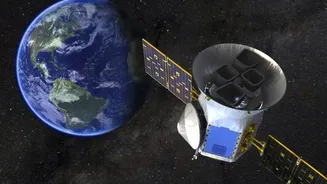
The Black Hole Hunters project uses a clever technique that relies on a principle from Einstein's theory of relativity: gravity bends light. When a black hole passes directly between us and a distant star, its gravity acts like a lens, briefly magnifying the star's light. This phenomenon is known as gravitational microlensing. For a black hole in a binary system with a star, this lensing effect can be periodic, causing the star to brighten in a specific, repeating pattern each time the black hole orbits in front of it. This recurring signal is precisely what volunteers are searching for. The data comes from NASA's Transiting Exoplanet Survey Satellite (TESS), a powerful space telescope designed to hunt for planets by monitoring the brightness of millions of stars. This makes its data perfect for finding the tell-tale brightening caused by a hidden black hole.
Why Human Eyes Are Crucial
With data from over 15 million stars, the sheer volume of information is immense. While artificial intelligence is used to perform an initial sift, identifying around one million potential candidates, AI still struggles to distinguish perfectly between a true microlensing event and other cosmic phenomena that cause stars to vary in brightness. This is where citizen scientists come in. The human brain remains superior at pattern recognition in noisy data. By looking at simple graphs showing a star's brightness over time, volunteers can spot the unique, sharp peaks that might indicate a black hole. According to the project organizers, no expert knowledge is required to participate. All it takes is an interest in space and a willingness to learn how to spot the key patterns. Since its launch on the Zooniverse platform, nearly 23,000 volunteers have already contributed.
How You Can Become a Black Hole Hunter
Getting started is straightforward. The project is hosted on Zooniverse, a well-established platform for citizen science. Aspiring hunters can visit the Black Hole Hunters project page, where they will find a simple tutorial. The process involves looking at 'light curves'—graphs that plot a star’s brightness. Volunteers are shown examples of what a potential microlensing event looks like and are asked to classify the plots they see. The interface is designed to be user-friendly, and you can contribute as much or as little time as you wish. According to Adam McMaster, a co-lead on the project from the University of Southampton, anyone can do it, and every participant has a chance to be the one who discovers a completely new type of system.
The Thrill of Discovery
The project isn't just about cataloging data; it's about genuine discovery. The black holes being sought are often in binary systems, orbiting a normal star. Finding these 'self_lensing' systems would be a first for astronomy and could provide crucial insights into how these pairs form and evolve. Your classifications directly contribute to real scientific research, helping professional astronomers narrow down the list of candidates for further investigation with other telescopes. By participating, you are not only helping to map the hidden population of black holes in our galaxy but also have the potential to make a discovery that could change our understanding of these enigmatic objects forever. It’s a unique opportunity to help make the invisible visible, right from your computer.