






The Cosmic Balancing Act
Imagine two large bowling balls, the Sun and Earth, resting on a stretched rubber sheet. Their weight creates deep dimples. Now, imagine rolling a small marble on this sheet. In most places, it would roll towards one of the two heavy balls. But there
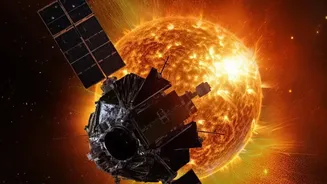
are a few special spots where the gravitational pulls from both balls, combined with the orbital motion, cancel each other out. These are called Lagrange points, named after the 18th-century mathematician Joseph-Louis Lagrange. There are five such points for any two-body system, like the Sun and Earth. Aditya-L1 is parked near the first one, L1, which lies directly on the line between the Sun and our planet.
Location, Location, Location: Why L1?
For a solar observatory, the L1 point is the ultimate front-row seat. From this vantage point, Aditya-L1 has a completely continuous and unobstructed view of the Sun. Unlike a satellite in a Low Earth Orbit (LEO), it never has to deal with the Earth or Moon passing in front, causing eclipses that interrupt vital data collection. This uninterrupted line of sight is crucial for studying dynamic solar events like coronal mass ejections (CMEs) and solar flares. Being at L1 means Aditya-L1 can spot solar storms heading towards Earth about an hour before they arrive, acting as a critical early warning system for our planet's satellites and infrastructure.
The 'Halo' Orbit Explained
While L1 is a point of gravitational equilibrium, it's an unstable one, like balancing a pencil on its tip. A tiny nudge could send the spacecraft drifting away. To solve this, ISRO placed Aditya-L1 not at the exact point, but in a large, three-dimensional 'halo orbit' around L1. This is not a simple circular path but a vast, irregular loop that keeps the spacecraft in the stable vicinity of L1 without ever getting too close to the Sun-Earth line where communications could be disrupted. This complex, egg-shaped orbit takes about 178 days to complete and ensures the mission's instruments can operate smoothly for years.
A Stable Platform for Science
This gravity-balanced orbit is what makes Aditya-L1 such a powerful scientific platform. The spacecraft carries seven sophisticated payloads, four for observing the Sun from afar and three for studying the local space environment. Instruments like the Visible Emission Line Coronagraph (VELC) and the Solar Ultraviolet Imaging Telescope (SUIT) need extreme stability to study the Sun's corona and chromosphere. The halo orbit provides just that. Meanwhile, in-situ instruments like the Plasma Analyser Package for Aditya (PAPA) can measure the solar wind and magnetic fields as they are, before they are distorted by Earth's own magnetic field.
Fuel Efficiency and Mission Longevity
One of the most significant advantages of this orbital strategy is fuel efficiency. Staying in a stable halo orbit requires very little fuel for periodic station-keeping manoeuvres—just small thruster burns to make minor corrections. This conservation of fuel is the key to a long mission life. ISRO has planned for a mission duration of five years, a feat made possible by the minimal energy needed to maintain this unique gravitational parking spot. This longevity will allow scientists to gather a wealth of long-term data on the Sun's behaviour and its impact on space weather, helping to solve mysteries like why the Sun's corona is millions of degrees hotter than its surface.