




Meet Shukrayaan-1: India’s Next Giant Leap
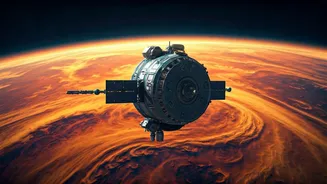
Following the monumental successes of Chandrayaan on the Moon and Mangalyaan at Mars, the Indian Space Research Organisation (ISRO) is embarking on its next great interplanetary adventure: a mission to Venus. Named Shukrayaan-1, from the Sanskrit words
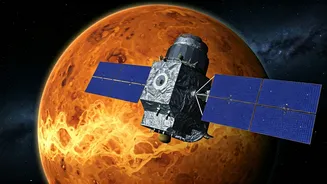
for Venus ('Shukra') and craft ('Yaan'), this orbiter represents India's first foray to the second planet from the Sun. Formally approved by the government in September 2024, the mission is currently slated for a launch in March 2028 aboard the powerful LVM-3 rocket. The spacecraft, with an expected mass of around 2,500 kg, will carry a suite of sophisticated instruments designed to peer beneath the planet’s dense clouds and unravel its long-held secrets. This mission solidifies India's position as a major player in planetary exploration, venturing to a world that remains one of the solar system's most enigmatic.
Why the Focus on Venus?
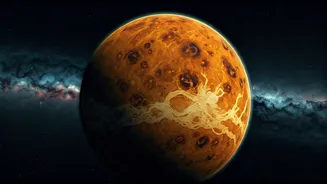
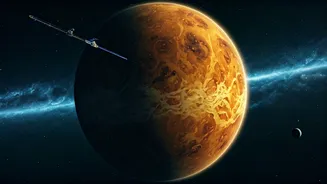
Venus is often called Earth’s twin, but it's a twin that went terribly wrong. It’s similar in size, mass, and density, and scientists believe it may have once hosted oceans and a climate much like our own. Today, however, it is a hellscape. Its atmosphere is over 90 times denser than Earth's and composed almost entirely of carbon dioxide, creating a runaway greenhouse effect that pushes surface temperatures to a lead-melting 460°C. The planet is shrouded in thick clouds of sulfuric acid, and its surface pressure would crush a submarine. Understanding why and how Venus transformed so dramatically is not just an academic question. It provides a real-world laboratory for studying extreme climate change, offering a cautionary tale for Earth and invaluable data for refining our own climate models. As ISRO Chairman S. Somanath noted, studying Venus is crucial because Earth itself was not always habitable and could change again.
The Mission’s Ambitious Science Goals
Shukrayaan-1 has a packed scientific agenda. Its primary goal is to perform a comprehensive investigation of Venus’s surface, subsurface, and atmosphere. To do this, it will carry around 19 scientific payloads developed by Indian institutions with key collaborations from Germany, Sweden, and Russia. One of the flagship instruments is a high-resolution Synthetic Aperture Radar (SAR), which can penetrate the dense cloud cover to map the surface with unprecedented detail, searching for signs of active volcanoes and lava flows. In a global first, the mission will also carry a ground-penetrating radar to study the planet's shallow subsurface, a feat no previous mission has attempted. Other instruments will analyse the complex atmospheric chemistry, including searching for traces of phosphine gas—a potential indicator of microbial life—and study the interaction between the solar wind and the Venusian ionosphere.
A Strategic Timeline
The headline's reference to 'speeding up' reflects the strategic nature of interplanetary missions. While earlier reports mentioned potential launch windows in 2024 or 2026, these were pushed due to factors like the pandemic and prioritisation of other national missions like Gaganyaan. The currently planned launch date of March 29, 2028, is set to take advantage of an optimal alignment between Earth and Venus. This alignment allows the spacecraft to reach Venus in a relatively short 112-day journey, arriving on July 19, 2028, while using the minimum amount of fuel. Missing this window would mean a long wait for the next favourable alignment. By firming up the 2028 date and finalising payloads, ISRO is moving decisively to execute this complex mission, ensuring India joins a new wave of international Venus exploration that includes upcoming missions from NASA and the European Space Agency.