



The Stratosphere: Earth’s Sunscreen
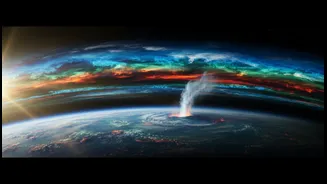
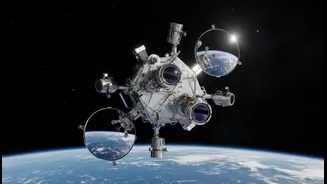
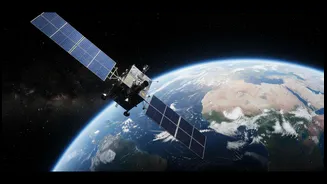
To understand the threat, we first need to look up—way up. The stratosphere, a layer of atmosphere roughly 10 to 50 kilometres above Earth, is a calm, stable region that's normally separate from the weather we experience daily. Its most famous feature
is the ozone layer, which acts like a global sunscreen, absorbing most of the Sun’s harmful ultraviolet (UV) radiation. For decades, scientists believed this layer was slowly healing thanks to global cooperation to ban ozone-depleting chemicals. But recent, powerful natural events are introducing unexpected variables into this recovery story.
Wildfire Smoke: A New Hole in Our Defenses
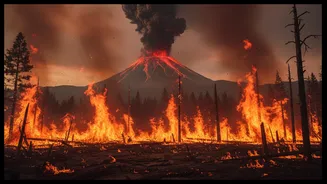
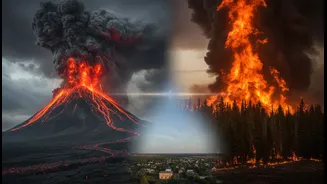
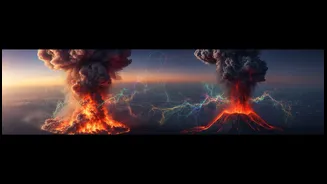
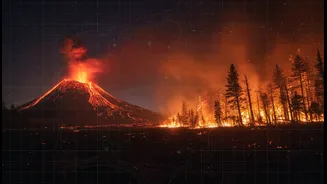
Intense wildfires are becoming more frequent and powerful, creating fire-driven thunderstorms called pyrocumulonimbus clouds. These storms act like elevators, punching smoke particles directly into the stratosphere, an altitude they would never normally reach. The 'Black Summer' fires in Australia in 2019-2020 provided a shocking case study, lofting over a million tons of smoke into the atmosphere. Scientists discovered that these smoke particles aren't inert. They provide surfaces for chemical reactions that destroy ozone. Studies showed that chemicals from old, banned CFCs, still lingering in the atmosphere, can react on the surface of these smoke particles to create ozone-destroying molecules. The Australian fires are estimated to have temporarily depleted 3-5% of the ozone layer in the mid-latitudes of the Southern Hemisphere and widened the Antarctic ozone hole by 10% in 2020. This has raised concerns that an increase in major wildfires could impede, or even reverse, the recovery of the ozone layer.
Volcanoes: More Than Just Cooling
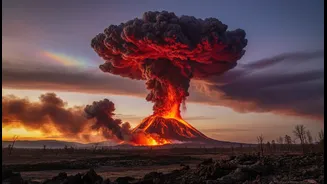
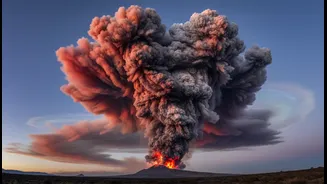
Traditionally, large volcanic eruptions like 1991's Mount Pinatubo were known for their cooling effect. They blast huge amounts of sulfur dioxide into the stratosphere, which forms a haze of sulfuric acid aerosols that reflects sunlight back into space, temporarily lowering global temperatures. This understanding was upended by the 2022 eruption of the Hunga Tonga-Hunga Ha'apai submarine volcano. It was the largest volcanic explosion in over a century, but its primary payload wasn't sulfur; it was water. The eruption injected a record-breaking amount of water vapour—a potent greenhouse gas—directly into the stratosphere, increasing its total water content by about 10%. While the sulfur from the eruption had a slight cooling effect, the massive injection of heat-trapping water vapour has a warming effect, creating a complex and ongoing scientific puzzle.
A Chemical Cocktail With Unknown Effects
The combination of wildfire smoke and unprecedented water vapour from volcanoes is creating a new chemical environment in the stratosphere. Scientists are racing to understand the consequences. Water vapour can enhance the ozone-depleting effects of other chemicals, and both water and smoke particles can affect stratospheric clouds and circulation patterns. The smoke particles from the Australian fires were found to have lingering effects on stratospheric chemistry for up to two years, far longer than anticipated, continually altering the balance of chlorine compounds that govern ozone depletion. This highlights how these events have long-lasting impacts that current models are only just beginning to capture.
Shaking Confidence In Our Forecasts
These new variables are a major challenge for climate models. Climate projections are built on the best available understanding of atmospheric physics and chemistry, but they have not historically accounted for sporadic, massive injections of wildfire smoke or water vapour into the stratosphere. The smoke from a single major fire event was found to linger for months, with a warming effect in the stratosphere that rivals the cooling effect of a moderate volcano. The unpredictability of when and where these events will occur, and in what magnitude, introduces a new layer of uncertainty into forecasts. This impacts not only long-term warming estimates but also short-term weather forecasting, as changes in the stratosphere can subtly influence weather patterns down below. If these extreme events become more common in a warming world, our ability to confidently predict future climate could be significantly hampered.