


A New Generation of Cosmic Explorer
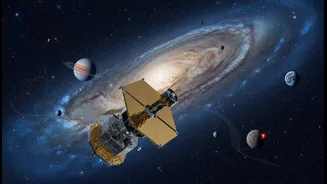
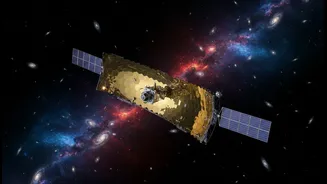
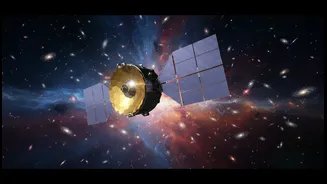
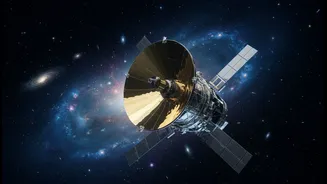
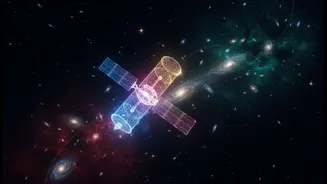
Scheduled for launch in the near future, the Nancy Grace Roman Space Telescope is NASA's next great observatory. Named after Nancy Grace Roman, the agency's first Chief of Astronomy, it carries a primary mirror the same size as Hubble's—2.4 meters in diameter.
But to compare it to Hubble on mirror size alone is to miss the point entirely. Roman's true power isn't just its sharpness, but its staggering field of view. Its Wide Field Instrument (WFI) will capture a patch of sky 100 to 200 times larger than Hubble can in a single shot, with the same breathtaking resolution. This ability to create vast, high-definition panoramas of the universe is at the heart of its main scientific quests: mapping the distribution of dark matter, measuring the expansion of the universe driven by dark energy, and conducting a massive census of exoplanets using a technique called gravitational microlensing.
The Power of the Panoramic View
While its missions to investigate dark energy and find new worlds are groundbreaking, the headline features only scratch the surface of Roman's potential. The real opportunity, the one that has scientists buzzing with anticipation, is the power of serendipity that its wide-field view unlocks. Unlike telescopes that focus on specific, pre-selected targets, Roman will be conducting massive surveys, continuously imaging huge swathes of the cosmos. In doing so, it will inevitably capture countless phenomena that astronomers weren't specifically looking for. It's the astronomical equivalent of taking a wide-angle photo of a cityscape and discovering countless dramas playing out in the windows. It’s this capability for surprise that could lead to the most revolutionary discoveries. One study suggests Roman's precision could uncover a vast, hidden population of isolated neutron stars, objects currently almost impossible to see.
An Engine for Unexpected Science
This survey-first approach transforms the telescope into an engine for what is known as time-domain astronomy—the study of how the universe changes over time. Roman will repeatedly scan the same regions, creating a dynamic map of the heavens. This allows it to spot transient events—cosmic phenomena that flare up and fade away. Simulations predict that Roman will detect tens of thousands of exploding stars, or supernovae, which are crucial for measuring cosmic distances. But it will also catch rarer events, like the tidal disruption that occurs when a star gets too close to a black hole, or the explosive merger of neutron stars, known as a kilonova. These are events that other telescopes often only observe after they've been spotted by ground-based surveys; Roman will find them on its own, providing a treasure trove of data for the global scientific community.
Beyond the Big Questions
The telescope's talents for discovery aren't limited to the exotic and the explosive. Roman is expected to be a master of asteroseismology, the study of 'star-quakes' or oscillations on the surface of stars. These vibrations reveal a star's internal structure, age, and size. Researchers believe Roman could measure these subtle flickers on hundreds of thousands of red giant stars, providing invaluable context for the planetary systems they host. This wasn't even part of the original mission plan; it’s an added bonus discovered by scientists studying the telescope's capabilities. This highlights the core of Roman's 'real opportunity': it’s a tool so powerful and versatile that scientists will be inventing new ways to use its data for decades, opening up scientific fields that we can barely imagine today.