





The Sun's Fury: More Than Just Sunshine
The Sun operates on an approximately 11-year cycle, moving from a quiet period (solar minimum) to a turbulent one (solar maximum). We are currently in Solar Cycle 25, which saw its activity peak between late 2024 and mid-2025. During this maximum, the
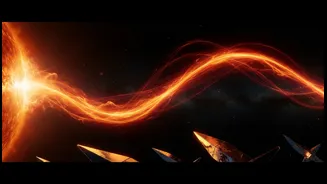
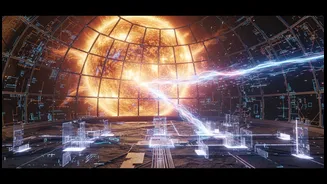
Sun's magnetic field becomes chaotic, leading to an increase in sunspots. These are magnetically intense regions that can erupt, unleashing solar flares—immense bursts of radiation—and coronal mass ejections (CMEs), which are giant clouds of charged particles hurled into space. While flares can disrupt high-frequency radio communications on Earth within minutes, CMEs are the primary threat to satellites, taking anywhere from hours to days to arrive.
The Threat to Our Orbital Lifeline
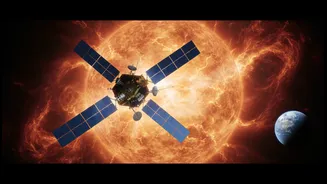
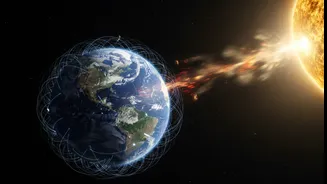
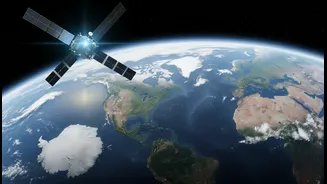
When a CME collides with Earth's magnetic field, it can have severe consequences for our orbital networks. The high-energy particles can fry sensitive electronics, a phenomenon known as a single-event effect (SEE). Over time, the cumulative radiation, or total ionizing dose (TID), degrades components, shortening a satellite's operational lifespan. Furthermore, the influx of energy heats and expands Earth's upper atmosphere. This increases atmospheric drag on satellites in Low Earth Orbit (LEO), causing their orbits to decay faster than expected. In one dramatic example from 2022, this increased drag caused 38 newly launched Starlink satellites to burn up. For services that rely on precise positioning, like GPS, these solar storms can disrupt signals and decrease accuracy for hours at a time.
The Art of Prediction: Eyes on the Sun
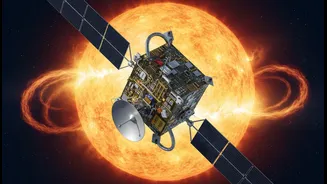
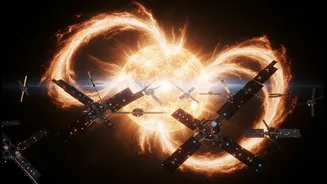
To protect these multi-billion dollar assets, researchers rely on a sophisticated network of observatories that provide early warnings. Space-based telescopes like NASA's Solar Dynamics Observatory (SDO) and the Geostationary Operational Environmental Satellite (GOES) network constantly monitor the Sun in X-ray and ultraviolet wavelengths, which are blocked by our atmosphere. They look for tell-tale signs of an impending eruption, such as changes in the magnetic fields of sunspot groups. India's own solar observatory, Aditya-L1, launched in 2023, provides a continuous view from a unique vantage point 1.5 million kilometers from Earth. Its instruments, like the Solar Ultraviolet Imaging Telescope (SUIT), are providing new insights into the initial moments of a flare, which is crucial for improving prediction models. On the ground, radio heliographs listen for radio bursts that often precede a CME. increasingly, machine learning algorithms are being used to analyze this constant stream of data in real-time, helping forecasters issue more timely and accurate alerts.
Shields Up: Mitigation in Action
Once a threat is identified, satellite operators have a playbook of defensive maneuvers. The most common response is to place the satellite into a 'safe mode'. This involves shutting down all non-essential systems, particularly sensitive scientific instruments, and orienting the satellite to protect its most vital components. This reduces the risk of electrical shorts and software glitches caused by charged particles. For long-term protection, satellites are built with resilience in mind. 'Radiation hardening' is a critical design philosophy that involves using specialized, radiation-resistant electronic components and materials. Strategic shielding, often using layers of aluminum or tantalum, is placed around critical systems to block incoming particles. Some designs use a technique called Triple Modular Redundancy, where three identical circuits perform the same task; if one is hit by a particle and gives an incorrect result, it is outvoted by the other two, ensuring the system continues to function correctly.