



The Sun’s Million-Degree Mystery
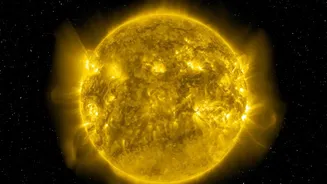
The Sun's outer atmosphere, the corona, is an enigma. It is hundreds of times hotter than the Sun's visible surface, reaching temperatures of a million degrees Celsius, yet it is so faint that it's completely invisible under normal circumstances. The Sun’s
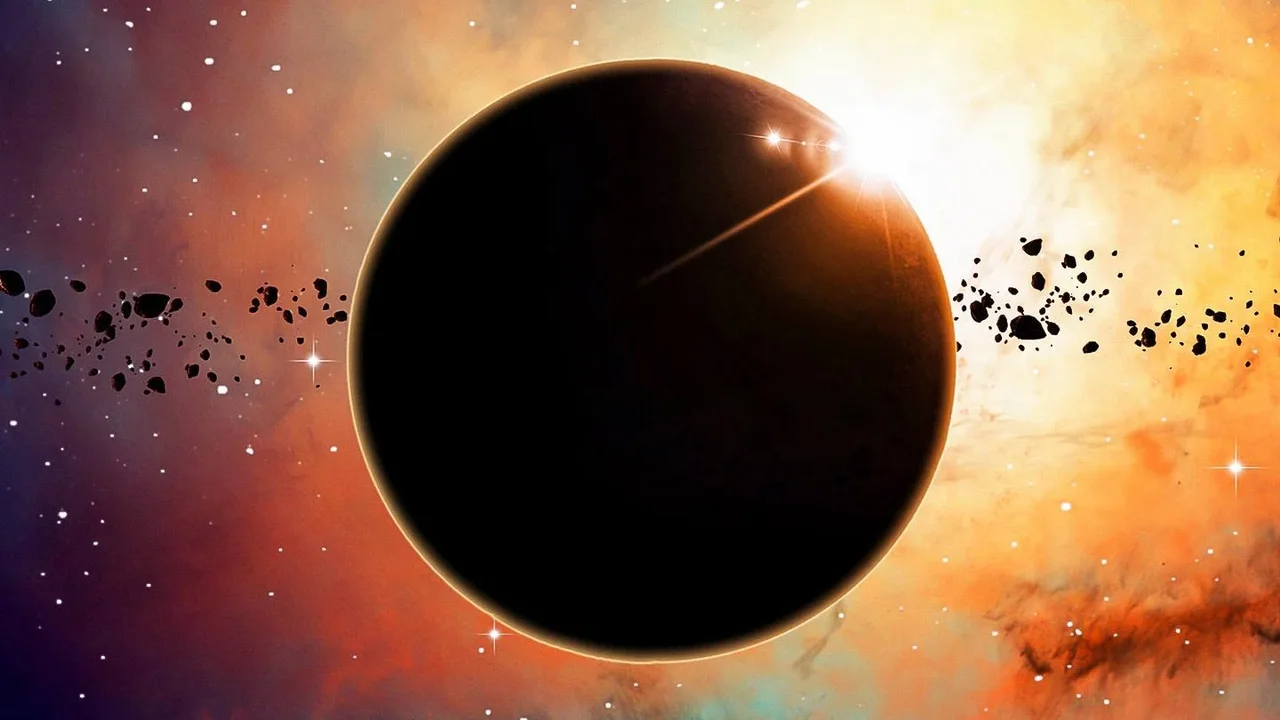
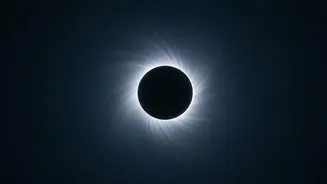
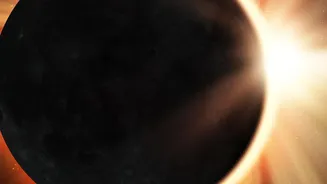
blinding glare washes it out, making it impossible to study directly. This is why total solar eclipses are so precious to solar physicists. When the Moon perfectly blocks the Sun's bright disk, the ethereal, pearly-white corona is revealed for a few precious minutes, offering a rare window into its complex structure and behaviour. Understanding the corona is crucial because it's the engine of space weather—the stream of charged particles and magnetic fields, known as the solar wind, that flows from the Sun and can impact satellites, communication systems, and even power grids on Earth.
A Coordinated Global Effort
The August 12, 2026, eclipse, which traced a path of totality over Greenland, Iceland, and Spain, prompted a massive coordinated scientific effort. NASA-funded teams used high-altitude research aircraft, like the WB-57, to chase the Moon's shadow. Flying at 50,000 feet, these jets could stay within the shadow for longer than ground-based observers, extending their observation time and flying above any clouds that might spoil the view. The jet was equipped with a suite of cameras capturing high-resolution images in different wavelengths of light, aiming to understand the formation of solar prominences—huge loops of gas suspended above the Sun's surface—and the mechanics of coronal heating. On the ground, teams in Spain were ready, though some observations were uniquely affected by local conditions. In Benavente, Spain, the corona appeared with an unusual golden hue, a phenomenon attributed to the Sun's low position on the horizon and smoke from nearby forest fires scattering blue light.
Eyes in the Sky, Data from Space
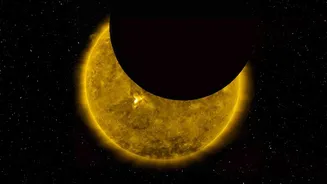
This eclipse was not just observed from Earth. A fleet of spacecraft provided a multi-dimensional view of the event. The European Space Agency's (ESA) Proba-3 mission, a pioneering duo of satellites flying in precise formation, created its own artificial eclipses to study the corona for extended periods—up to six hours at a time. This mission provided a unique baseline, capturing views of the corona just before the natural eclipse and helping to predict its structure. Meanwhile, ESA's Solar Orbiter, which studies the Sun from a different vantage point, used its instruments to create magnetic maps of the solar surface. This data was fed into sophisticated computer models to forecast what the corona would look like, allowing scientists to test and refine their understanding of the Sun's complex magnetic environment. This synergy between ground-based observations, airborne missions, and space-based probes created an unprecedentedly comprehensive dataset.
Initial Findings and Future Questions
While it will take months, if not years, to fully analyze the torrent of data collected on August 12, initial results and long-term studies are already yielding insights. Research combining data from multiple eclipses has identified turbulent, smoke-ring-like structures within the corona that originate from solar prominences. This turbulence is a key piece of the puzzle in understanding how energy is transferred into the solar wind. Furthermore, data from formation-flying missions like Proba-3 has already surprised scientists, revealing that parts of the 'slow' solar wind are moving three to four times faster than predicted so close to the Sun. Each eclipse provides a unique snapshot because the Sun is constantly changing. The observations from the 2026 event, capturing a specific moment in the solar cycle, will help scientists build more accurate models of space weather. These models are essential for protecting our increasingly technology-dependent world from the Sun's powerful outbursts.