




A Fundamental Shift in Space Communication
For decades, space missions have relied on radio waves to send and receive data. This method has been the backbone of space exploration, from the first satellite flybys to the complex operations of Mars rovers. However, radio frequency (RF) communication
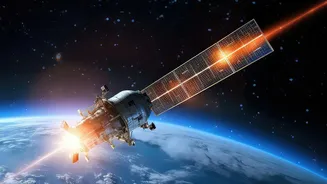
has its limits. As scientific instruments become more powerful, capturing vast amounts of high-resolution data, the process of sending that information back to Earth has created a significant bottleneck. Transmitting a single high-resolution image from Mars could take over an hour, and a full map of the planet might take weeks. This is where optical communication, using infrared lasers, represents a monumental leap forward. Instead of radio waves, it uses light to carry information, offering a much wider pipeline for data to flow.
The Laser Advantage: More Data, Less Power
So, why are lasers so much better? It comes down to frequency and focus. Infrared light has a much higher frequency than radio waves, allowing it to be packed with significantly more data. Think of it like upgrading from a dial-up modem to a fibre-optic broadband connection. A recent demonstration by NASA's Deep Space Optical Communications (DSOC) experiment achieved a maximum download speed of 267 megabits per second (Mbps) from 19 million miles away—a speed comparable to many home internet plans. Furthermore, laser beams are far more focused than radio waves. This tight focus means the signal is stronger and more secure, reducing the risk of interception. This efficiency also translates to the spacecraft itself; laser communication systems are smaller, lighter, and require less power than their radio-based counterparts, freeing up precious mass and energy for more scientific instruments.
How It Actually Works: From Spacecraft to Telescope
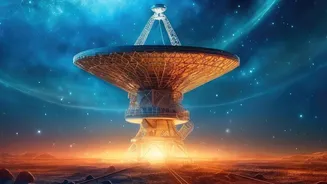
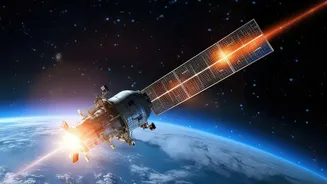
The process is a marvel of engineering. Aboard a spacecraft, like NASA's Psyche mission, a flight laser transceiver encodes data into a near-infrared laser beam. This isn't a laser you can see; it exists just outside the visible spectrum of light. That laser is then beamed across millions of miles of empty space. The biggest challenge is precision. Aiming the laser requires hitting a target the size of a coin from a mile away, all while both the spacecraft and Earth are in constant motion. To achieve this, a ground station on Earth, like the one at JPL's Table Mountain Facility, first sends an uplink laser beacon to the spacecraft. The spacecraft’s transceiver locks onto this beacon to perfectly aim its return signal. The high-definition video or scientific data then travels as light pulses to a massive ground-based receiver, like the 200-inch Hale Telescope at Palomar Observatory, which has been outfitted with highly sensitive detectors capable of counting individual photons.
Putting the Technology to the Test
The DSOC experiment, which launched aboard the Psyche spacecraft in October 2023, has been a resounding success. In a landmark test, the system streamed the first-ever ultra-high-definition video from deep space—a 15-second clip of a cat named Taters chasing a laser pointer. The video traveled 19 million miles in just 101 seconds. Since then, the system has continued to break records, successfully transmitting engineering data from as far as 140 million miles away. These tests prove that the technology is not just theoretical but a practical and robust solution for the future of space communication, capable of functioning over the vast distances required for missions to Mars and beyond.
Paving the Way for a New Era of Exploration
The implications of high-speed laser communication are enormous. It will enable future astronauts on missions to Mars to have real-time, high-definition video calls with Earth, a crucial link for both operational support and morale. Scientists will be able to receive massive datasets from planetary probes almost instantly, accelerating the pace of discovery. We could receive complex scientific information, high-definition imagery, and live video feeds that will support humanity's next giant leaps into the solar system. This technology is not just an upgrade; it's a foundational component for building a sustained human presence on the Moon and preparing for our first steps on Mars.