




A Sharper Eye on the Cosmos
The game-changer in this new era of astronomy is advanced imaging technology, most famously embodied by the James Webb Space Telescope (JWST). Positioned nearly a million miles from Earth, the JWST is an infrared observatory, meaning it can detect light
that is invisible to the human eye. This capability is crucial because as the universe expands, the light from the most distant objects gets stretched out, shifting from visible light into the infrared spectrum. This phenomenon, known as redshift, means conventional telescopes were effectively blind to the universe's earliest and most distant galaxies. With its massive gold-plated mirror and sensitive instruments, the JWST can capture this faint, ancient light, allowing scientists to see galaxies that formed just a few hundred million years after the Big Bang.
Peering Back to the Dawn of Time
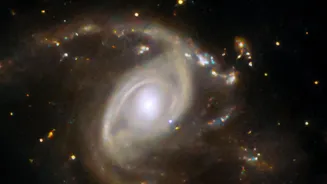
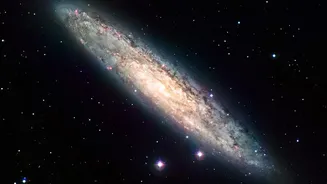
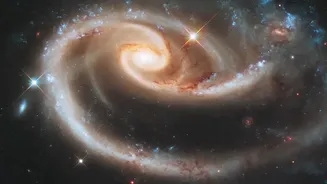
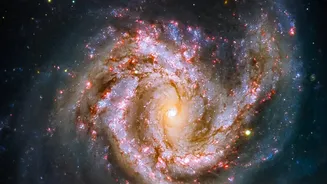
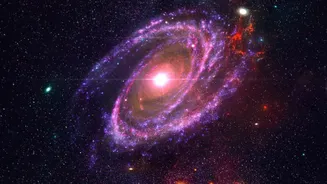
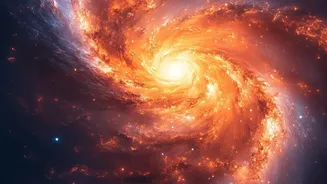
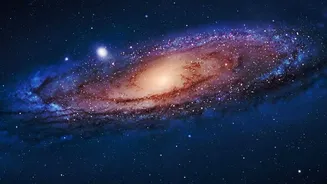
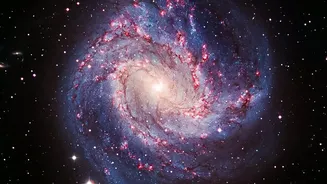
Observing these faraway galaxies is fundamentally an exercise in time travel. Because light travels at a finite speed, the light we receive today from a galaxy 13 billion light-years away has spent 13 billion years journeying through space. We are therefore seeing that galaxy not as it is today, but as it was 13 billion years ago, when the universe itself was still in its infancy. This allows astronomers to piece together the story of cosmic evolution, witnessing firsthand how the first stars ignited and how primordial clouds of gas slowly coalesced into the grand spiral and elliptical galaxies we see in the modern universe. It's like finding a cosmic photo album that documents the universe's awkward teenage years.
Rewriting the Cosmic History Books
The insights gained from these new images are already challenging long-held theories. Models predicted that the first galaxies would be small, chaotic, and disorganized. However, the JWST is finding galaxies in the early universe that appear surprisingly mature, bright, and structured. Some galaxies observed from a time when the universe was just 300 million years old are already showing significant brightness and complexity, forcing scientists to rethink how quickly the first stars could have formed. Discoveries of elements like carbon and nitrogen, forged in the hearts of stars, in such ancient galaxies suggest that stellar life cycles and galaxy formation were perhaps more efficient and rapid than previously believed.
The Rise of the AI Astronomer
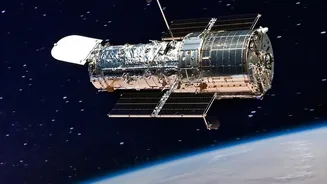
This flood of unprecedented data from JWST and other survey telescopes like the Hubble Space Telescope presents a new challenge: there is simply too much information for humans to analyze alone. This is where Artificial Intelligence is stepping in to become a crucial partner in discovery. AI and machine learning algorithms are now being deployed to sift through millions of images, identifying subtle patterns, classifying galaxies, and flagging anomalies that a human researcher might miss. These automated systems can process vast datasets in days, a task that would take humans years. This combination of advanced optics and intelligent software is accelerating the pace of discovery, turning astronomy into a field driven as much by data science as by looking through an eyepiece.
More Questions Than Answers
For all the new knowledge these technologies provide, they are also unveiling deeper mysteries. The existence of these 'impossibly' mature early galaxies raises fundamental questions about the conditions of the early universe. Did stars form more efficiently? Was the process of galaxy assembly faster than our models allow? Some findings are so unexpected they are forcing a re-examination of the foundational principles of cosmology. While these new observations don't disprove the Big Bang, they add wrinkles and complexities that scientists are now eagerly trying to understand. Each new image seems to answer one question while posing several more, proving that the universe is far from a solved puzzle.