


The 'Seven Minutes of Terror' for Everyone
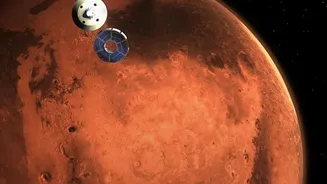
Any landing on Mars, robotic or human, must survive what engineers at NASA call the 'seven minutes of terror'. This is the timespan for Entry, Descent, and Landing (EDL), where a craft arriving at hypersonic speed must perfectly execute a series of manoeuvres
to touch down safely. The core problem is the Martian atmosphere: it's thick enough to create searing heat from friction, yet less than 1% as dense as Earth's, making it almost useless for slowing down with parachutes alone. A vehicle hits the atmosphere at around 20,000 km/h, uses a heat shield to endure peak temperatures, deploys a parachute while still supersonic, and finally uses rockets for the last phase of descent. This sequence is brutally unforgiving, which is why only about half of all missions sent to the Martian surface have ever landed successfully.
Robotic Landings: A Game of Mass and Autonomy
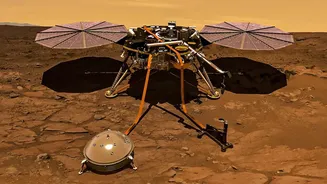
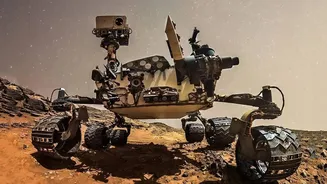
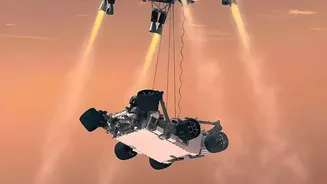
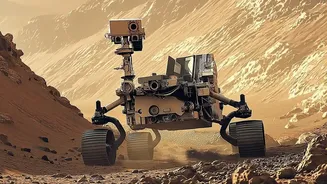
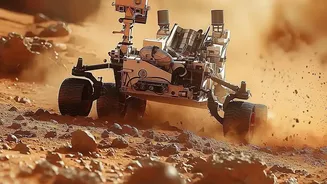
To date, every successful Mars landing has been robotic. These missions have grown in sophistication, from the 0.6-metric-ton Viking landers to the Perseverance rover, which weighs about one metric ton. For these missions, the primary challenge is perfecting the autonomous EDL sequence. With a communication delay of up to 24 minutes each way, there is no real-time control from Earth; the spacecraft must handle everything on its own. Engineers have developed ingenious solutions like the 'sky crane' manoeuvre used for the Curiosity and Perseverance rovers, which lowered the vehicles to the surface from a hovering rocket-powered backpack. However, even these advanced systems are pushing the limits of what's possible with current technology. The size of parachutes and the power of retrorockets are constrained, effectively capping the landed mass at just over a single tonne.
The Human Factor: A New Order of Magnitude
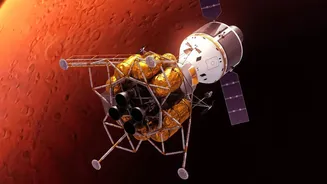
Landing humans on Mars is an entirely different problem, primarily due to one factor: mass. A crewed mission wouldn't just be landing a small vehicle; it would need to deliver a habitat, life support systems, supplies, and a vehicle for returning to orbit. Current estimates suggest a human-class lander would need to weigh between 40 and 80 metric tons. This is more than 20 times heavier than the Perseverance rover, rendering Viking-era EDL technology, based on parachutes and small rockets, completely obsolete. At this scale, parachutes become ineffective, as they simply can't generate enough drag to slow such a heavy object in Mars's thin air. This massive increase in payload requires a fundamental rethinking of how to land on the Red Planet.
Precision, Safety, and Site Preparation
Unlike a rover that can land within a wide ellipse, human missions require pinpoint accuracy. Astronauts will need to land within a few dozen meters of pre-positioned supplies, habitats, or ascent vehicles. This demands advanced navigation systems that can actively divert the spacecraft to avoid hazards like large rocks or unstable ground during the final seconds of descent. Furthermore, the powerful engines needed to slow an 80-ton lander could create their own hazards by kicking up rocks at high speeds or blasting a deep crater into the landing zone, potentially destabilizing the site. This has led to concepts of sending robotic missions first to prepare a hardened landing pad. Above all, human missions require near-absolute reliability and abort capabilities that are not a priority for disposable robots.
The Future: Supersonic Retropropulsion
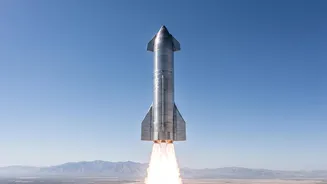
To solve the mass problem, space agencies and commercial companies are developing a technology called Supersonic Retropropulsion (SRP). The idea is to fire powerful engines forward into the direction of travel while the vehicle is still moving at supersonic speeds. This uses engine thrust, rather than fragile parachutes, to do the heavy lifting of deceleration. This approach is a key component of SpaceX's Starship architecture and is considered an enabling technology for high-mass landings. While SRP burns a lot of propellant, it is currently the only feasible architecture identified that can land the immense payloads required for a human outpost on Mars. Perfecting this technology, along with inflatable heat shields and advanced autonomous navigation, is the critical next step in turning the dream of sending humans to Mars into a reality.