







Artemis II: Humanity's Farthest Journey in 50 Years
The Artemis program is NASA's ambitious plan to return humans to the Moon, and 2026 is the year it takes its most significant step yet. After multiple delays, the Artemis II mission successfully launched on April 1, 2026, sending four astronauts on a historic
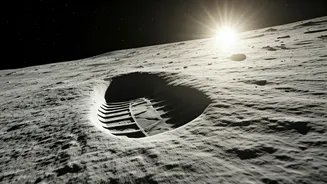
flyby of the Moon. [15, 20] This ten-day mission marked the first time humans have traveled beyond low Earth orbit since the Apollo era, which ended in 1972. [15, 20] The crew—Christina Koch, Victor Glover, Reid Wiseman, and Jeremy Hansen—ventured farther into space than any human before them, testing the Orion spacecraft's life-support systems and capabilities in deep space. [15] While not a lunar landing, Artemis II is a crucial dress rehearsal. Its success paves the way for future missions, including Artemis IV, now slated to be the first to land astronauts on the lunar surface in this new era, currently targeted for early 2028. [4, 15, 20] The story of Artemis in 2026 is one of a triumphant return to deep space, reigniting the dream of lunar exploration for a new generation.
Hera's Rendezvous: A Post-Impact Asteroid Investigation
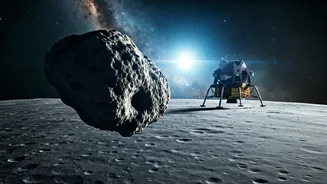
In a remarkable feat of planetary defense, NASA's DART mission successfully crashed into the asteroid Dimorphos in 2022 to alter its orbit. [10] Now, in 2026, we're finally going back to see the results up close. The European Space Agency's (ESA) Hera mission is scheduled to arrive at the Didymos-Dimorphos asteroid system in November 2026. [1, 2] Launched in October 2024, Hera's primary goal is to conduct a detailed post-impact survey of the asteroid that DART struck. [8, 9] This mission is critical for turning the kinetic impact experiment into a well-understood and repeatable planetary defense technique. [8] Hera will measure Dimorphos's mass, study the crater left by DART, and analyze the asteroid's composition. [10] It isn't traveling alone; it will deploy two smaller CubeSats, Milani and Juventas, for even closer investigation. [1, 8] Hera's arrival at the end of this year will begin a new chapter in our ability to protect Earth from potential asteroid threats, providing the ground-truth data needed to validate our defense models.
New Players Target the Moon and Beyond
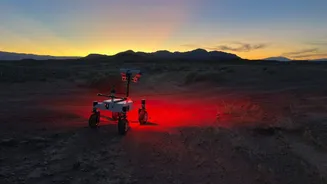
While Artemis grabs headlines, 2026 is also a banner year for other international and commercial lunar efforts. China's ambitious Chang'e 7 mission is expected to launch for the Moon's south pole this year, deploying an orbiter, lander, rover, and a unique mini-flying probe designed to explore permanently shadowed craters for signs of water ice. [2, 3, 7] This follows a trend of increasing focus on the lunar south pole as a site for potential resources. [2] Meanwhile, Japan's Martian Moons Exploration (MMX) mission is slated to launch in November 2026. [2, 11] Its audacious goal is to land on Mars's moon Phobos and return a sample to Earth, which could finally solve the mystery of whether Mars's moons are captured asteroids or remnants of a giant impact. [2, 11] These missions underscore a global shift, where multiple nations and private entities are pushing the boundaries of exploration, transforming the space race into a collaborative, multi-faceted international endeavor.
A 'Great Comet' That Wasn't (For 2026)
For a time, astronomers eagerly anticipated that Comet C/2023 A3 (Tsuchinshan-ATLAS) might become a 'great comet' visible to the naked eye. Discovered in early 2023, predictions pointed to a spectacular show in the autumn of 2024. [23, 25] The comet did indeed put on a stunning display, reaching its closest point to the Sun in late September 2024 and becoming exceptionally bright, with some observations reporting it as one of the brightest comets in decades around early October 2024. [23, 24] However, by 2026, the show is long over. The comet has since been traveling away from the inner solar system. [17, 22] As of June 2026, it is incredibly faint and far away, receding back into the cosmic deep from which it came. [17] While it was a major astronomical story of 2024, its chapter in our night sky has closed, reminding us of the fleeting, yet beautiful, nature of celestial visitors.