



The Power of Smart Variation
The principle of progressive overload is the foundation of getting stronger. To keep adapting, your muscles need new challenges. But that doesn't always mean lifting heavier weights. By altering the type of exercise that hits a certain muscle group, you can
create a new stimulus for growth without starting from scratch. This is where variations come in. Tweaking a familiar movement can recruit different stabilising muscles, challenge your coordination, improve your mobility, and prevent the boredom that leads to plateaus. It's about evolving your workout, not revolutionising it every week. This approach allows your muscles, and just as importantly, your connective tissues like tendons and ligaments, to adapt gradually, reducing the risk of injury that can come from progressing too quickly.
Upgrade Your Squat
The basic bodyweight squat is a foundational movement for lower body strength, targeting your glutes, quadriceps, and hamstrings. To perform it correctly, stand with feet shoulder-width apart, keep your back straight, and lower your hips as if sitting in a chair, ensuring your knees track over your toes. Once you have mastered this with good form, you can explore variations. A Box Squat, where you tap your hips to a bench, helps build confidence and control. A Goblet Squat, holding a weight at your chest, engages your core more intensely and helps you stay upright. For a greater challenge, Bulgarian Split Squats, with your back foot elevated on a bench, isolate one leg at a time, powerfully building single-leg strength and stability.
Progress Your Push-Up
The push-up is a quintessential upper-body and core exercise. Every push-up is a plank in motion, demanding a straight line from your head to your heels and an engaged core. If a standard push-up is too difficult, start with an Incline Push-Up, placing your hands on a stable, elevated surface like a bench or wall. As you get stronger, you can lower the incline until you’re on the floor. For those who have mastered the standard version, variations can add a new level of difficulty. Diamond Push-ups, with your hands close together under your chest, place more emphasis on your triceps. Hand-release push-ups, where you lift your hands off the floor at the bottom of the movement, build explosive power from a dead stop.
Strengthen Your Plank
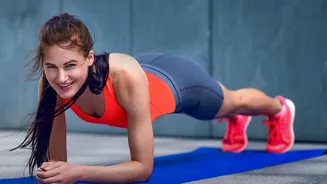
The plank is a masterclass in core stability, strengthening the deep abdominal muscles that support your spine. For a proper plank, rest on your forearms with elbows under your shoulders, and form a straight line from head to heels, bracing your abs and glutes. To progress from a basic hold, you can add movement. A Plank with a Leg Lift challenges your core to resist rotation as you remove a point of contact with the floor. Side Planks are excellent for targeting the obliques, the muscles on the sides of your torso. For a dynamic challenge, try Plank Hip Dips, where you slowly rotate and lower your hip to tap the floor on each side, building strength through a greater range of motion.