



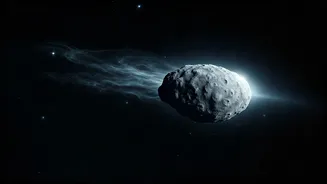


A Visitor from Beyond
On July 1, 2025, astronomers operating the Asteroid Terrestrial-impact Last Alert System (ATLAS) in Chile spotted an object moving in a way that defied explanation. Unlike the planets, comets, and asteroids born in our own solar system, this visitor was
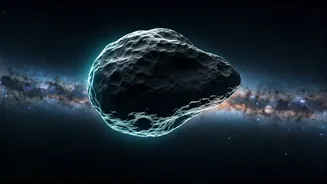
not gravitationally bound to our Sun. Its path was a hyperbola—a clear indication that it had come from interstellar space and would eventually return to it. It was named 3I/ATLAS: the third (3) interstellar (I) object, discovered by the ATLAS survey. This followed the discoveries of the mysterious 'Oumuamua in 2017 and the more conventional comet 2I/Borisov in 2019. Each such object is a priceless scientific opportunity—a physical sample from another solar system delivered, for a short time, to our doorstep.
The Global Hunt for Clues
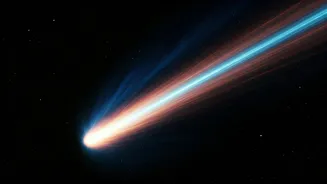
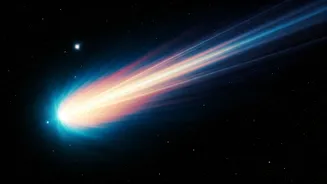
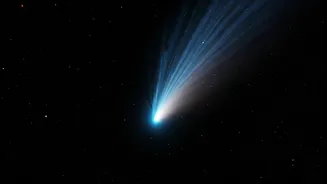
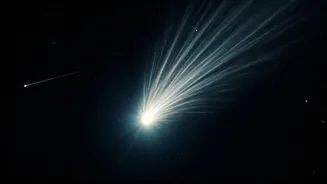
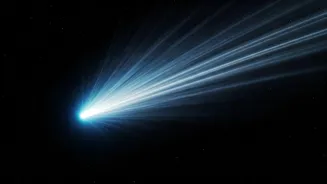
The announcement of 3I/ATLAS's interstellar origin triggered a worldwide astronomical campaign. Telescopes big and small, on the ground and in space, turned their gaze toward the speeding guest. The Hubble and James Webb Space Telescopes analyzed its composition, while missions like ESA's Jupiter Icy Moons Explorer (Juice) tracked it from unique vantage points. These observations revealed 3I/ATLAS to be an active comet, complete with a fuzzy coma of gas and dust. By studying the light it reflected and the gases it emitted as it neared our Sun, scientists began to piece together a chemical fingerprint. Initial findings suggest it is rich in carbon dioxide and may have formed in an extremely cold region of its home system. Some studies even speculate it could be billions of years old, perhaps older than our own solar system.
What ATLAS Is and Why It Matters
The discovery was made possible by ATLAS, a NASA-funded survey system developed by the University of Hawaii. Comprising four telescopes located in Hawaii, Chile, and South Africa, ATLAS scans the entire night sky every 24 hours. Its primary mission is planetary defense—to find near-Earth asteroids days or weeks before a potential impact. However, by constantly watching for anything that moves or changes in the sky, it's also perfectly suited to spot rare transients like interstellar visitors. The system automatically flags moving objects and reports them to the Minor Planet Center, where a global network of astronomers can perform follow-up observations to confirm their nature and trajectory. This rapid, collaborative process was crucial in identifying 3I/ATLAS so quickly.
Connecting the Dots Across the Galaxy
So, how does a visitor like this make space feel more connected? For one, it provides tangible proof that the building blocks of solar systems are not isolated. The materials that formed our Earth are likely not unique. By studying the composition of 3I/ATLAS, we learn about the chemistry of a distant, unseen planetary system. These objects are essentially messages in a bottle, thrown out from another star's gravitational embrace millions of years ago, carrying clues about their origin. Furthermore, the discovery itself is a deeply human and collaborative act. From the automated telescopes of ATLAS to the coordinated efforts of observatories across multiple continents and space agencies, the study of 3I/ATLAS connects scientists and space enthusiasts in a shared pursuit of knowledge. It reminds us that our solar system is not an island, but a small part of a vast and dynamic galaxy full of other worlds and other stories.