





A Mission of Historic Ambition
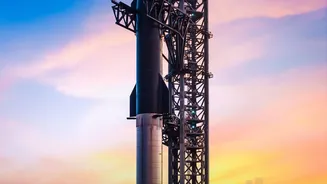
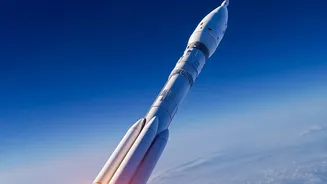
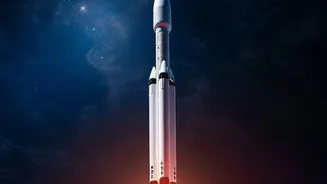
The 15th test flight of the Starship system had a goal that sounded like science fiction: launch the world’s most powerful rocket, have both its massive stages return to the launch site, and catch them both out of the sky with a giant pair of mechanical
arms. The mission, which began with a liftoff from Starbase in Texas on November 13, aimed to prove the core principle of SpaceX's vision: total and rapid reusability. In addition to the recovery attempt, the Starship upper stage was tasked with deploying 26 Starlink satellites into orbit, a goal it successfully achieved.
The 'Holy Grail': A Perfect Starship Catch
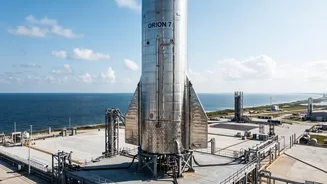
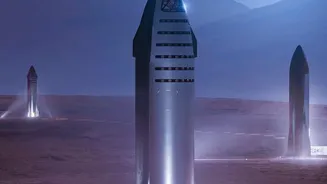
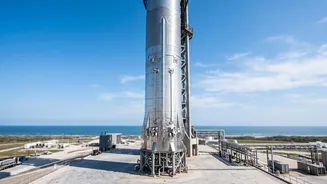
After orbiting the Earth 14 times over 22.5 hours, the Starship upper stage began its fiery descent. Spectators and engineers watched as the 171-foot-tall vehicle survived reentry, performed a complex flip maneuver, and descended toward the launch tower, nicknamed 'Mechazilla'. In an unprecedented moment, the tower's 'chopstick' arms closed around the ship, securing it in a clean catch. SpaceX commentators hailed the achievement as the 'holy grail of spaceflight', a maneuver that had never before been successfully attempted. This single success is a monumental leap toward making an orbital-class vehicle as reusable as an airplane.
The Booster's Unplanned Detour
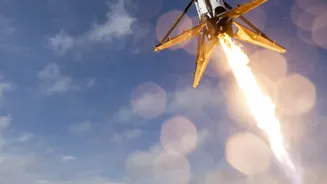
While the Starship's return was a triumph, the mission's first act did not go to plan. Shortly after separating from the upper stage, the Super Heavy booster initiated its return sequence. However, an issue a few minutes into the flight, later identified as a low-fuel alarm, triggered an automated abort. Instead of heading back to the launch tower for its own catch, the booster was diverted to a safe location over the Gulf of Mexico, where it exploded. This marked the primary setback for a mission that aimed for a flawless 'double catch'.
Why Catching Rockets Changes Everything
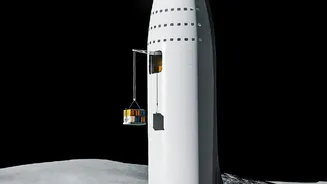
Catching both the booster and the ship directly on the launch tower is the cornerstone of SpaceX’s business model for Starship. This method eliminates the need for costly and time-consuming ocean recoveries and allows the vehicles to be quickly inspected, refueled, and stacked for another flight. Full and rapid reusability is expected to dramatically slash the cost of getting to orbit, making ambitious projects viable. These include building out the vast Starlink internet constellation and supporting NASA's Artemis program, which will use a version of Starship to land astronauts on the Moon.
A Net Win on the Path to Mars
Despite the loss of the Super Heavy booster, the successful catch of the Starship upper stage is being widely viewed as an overwhelming success for SpaceX. The upper stage's journey is far more complex, involving higher speeds and the extreme heat of orbital reentry, making its recovery the harder and more critical half of the equation. While the booster landing remains a hurdle to be perfected, proving that the ship can be plucked from the sky turns a key piece of founder Elon Musk's long-term vision into a demonstrated reality. This achievement moves the company significantly closer to its ultimate goals of establishing a human presence on Mars and transforming the economics of space travel.